Physics · Ch 9 — Mechanical Properties of Fluids
Angle of Contact
Angle of Contact
Angle of Contact
When a liquid meets a solid surface, the liquid surface near the wall is generally curved. This curvature is not accidental — it arises from the competition between adhesive forces (liquid–solid) and cohesive forces (liquid–liquid). The angle of contact (or contact angle) is the angle that the tangent to the liquid surface makes with the solid surface, measured inside the liquid.
More precisely: at the point where the liquid, solid, and vapour (or air) meet — the three-phase contact line — draw the tangent to the liquid–vapour interface. The angle between this tangent and the solid surface, measured through the liquid, is the angle of contact, denoted by .
The angle is always measured inside the liquid. If the liquid bulges upward (like water in a glass tube), the tangent slopes upward and is acute. If the liquid curves downward (like mercury on glass), the tangent slopes downward and is obtuse.
The value of depends on the relative strengths of adhesion and cohesion:
- If adhesive forces dominate, the liquid spreads on the solid — is small (less than ). Such a liquid is said to wet the solid.
- If cohesive forces dominate, the liquid beads up — is large (greater than ). Such a liquid does not wet the solid.
For water and clean glass, (complete wetting). For mercury and glass, (non-wetting). For water and wax, .
Do not confuse the angle of contact with the angle of the meniscus at the wall. The meniscus is the curved liquid surface itself; the angle of contact is the angle that surface makes with the solid at the line of contact.
Properties of the Angle of Contact
Two important properties of the angle of contact follow from the balance of surface tensions at the three-phase contact line.
Property 1: The angle of contact depends on the nature of the liquid and the solid in contact
This is a direct consequence of the fact that is determined by the intermolecular forces between the liquid molecules themselves (cohesion) and between the liquid and solid molecules (adhesion). Different liquid–solid pairs have different relative strengths of these forces, so varies. For example, water wets glass but not wax; mercury does not wet glass but wets clean zinc.
Property 2: The angle of contact depends on the medium above the free surface of the liquid
The liquid–vapour interface is one of the three surfaces meeting at the contact line. If the vapour above the liquid is replaced by a different gas (or by another immiscible liquid), the surface tension of the liquid–vapour interface changes. Since the balance of tensions at the contact line involves this surface tension, changes accordingly.
The angle of contact is not a fixed material constant for a given liquid and solid — it depends on the third phase (the surrounding fluid) as well.
Derivation of the Angle of Contact from Force Balance
At the three-phase contact line, three surface tensions act along the three interfaces:
- — solid–liquid surface tension (tends to reduce the solid–liquid area)
- — solid–vapour surface tension (tends to reduce the solid–vapour area)
- — liquid–vapour surface tension (tends to reduce the liquid–vapour area)
These three forces per unit length act along the respective interfaces, tangential to them. For the contact line to be in equilibrium, the horizontal components must balance. The vertical component of is balanced by the reaction of the solid surface (the solid is rigid and does not deform).
›Proof
Consider the contact line where the three phases meet. The surface tension pulls the contact line along the solid surface, away from the liquid. The surface tension pulls it along the solid surface, toward the liquid. The liquid–vapour surface tension pulls at an angle to the solid surface (measured inside the liquid).
Resolve into horizontal and vertical components:
- Horizontal component: (pointing away from the liquid if )
- Vertical component: (balanced by the normal reaction of the solid)
For horizontal equilibrium:
Rearranging:
This is Young's equation (or the Young–Dupré equation). It gives the equilibrium contact angle in terms of the three surface tensions.
From this equation, we see:
- If , then , so — the liquid wets the solid.
- If , then , so — the liquid does not wet the solid.
- If , then , so — complete wetting (the liquid spreads into a thin film). …
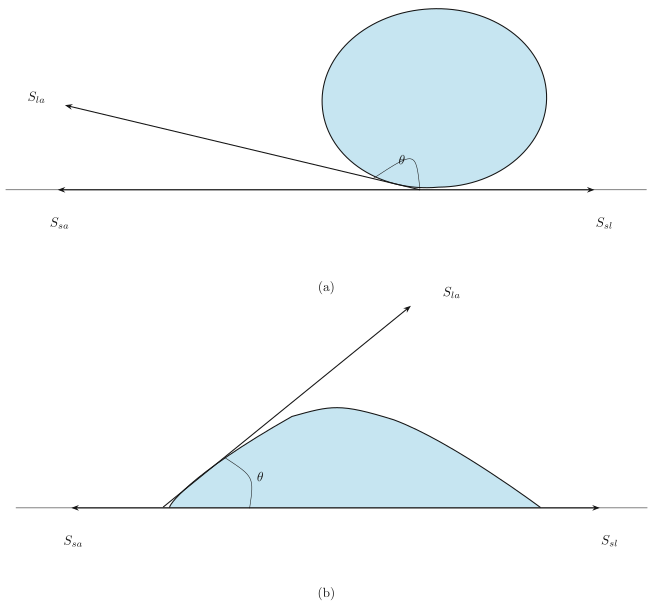
Drawn by us to help you understand the concept clearly, and verified to make sure it's accurate. For exams, practice from your textbook's own diagram.
Figure 9.17 is a side-by-side comparison of two water drops on different solid surfaces. In panel (a), the drop sits on a lotus leaf. It is nearly spherical, almost a perfect bead, and it makes an obtuse contact angle with the solid. In panel (b), the same drop sits on a clean plastic plate. Here the drop is flattened and spread out, making an acute contact angle with the surface.
Both panels show the same three interfacial tensions, drawn as arrows acting at the point where the three phases meet — the three-phase contact line. is the liquid-air surface tension, pulling tangentially along the liquid-air interface. is the solid-air surface tension, pulling along the solid-air interface. is the solid-liquid surface tension, pulling along the solid-liquid interface. The angle is measured inside the liquid, between the solid-liquid and liquid-air interfaces.
The physical idea is that a drop's shape is determined by the balance of these three tensions. On the lotus leaf, is much larger than , so the net force pulls the contact line outward, making the drop bead up. On the clean plastic, is larger, pulling the contact line inward and causing the drop to spread.
The textbook develops the key formula for this balance by considering the horizontal components of the three tensions at the contact line. At equilibrium, the net horizontal force must be zero:
This is Young's equation. Each symbol is:
- — solid-air interfacial tension (the energy per unit area of the solid-air interface)
- — solid-liquid interfacial tension
- — liquid-air interfacial tension (often called the surface tension of the liquid)
- — the contact angle, measured inside the liquid
Young's equation is the fundamental relation for wetting. If , the liquid wets the solid (spreads). If , the liquid does not wet the solid (beads up). The lotus leaf case (a) gives ; the plastic plate case (b) gives . …