Q.Figure 9.21
You're viewing a preview — the full solution, concept, methods & PYQ mapping are locked.
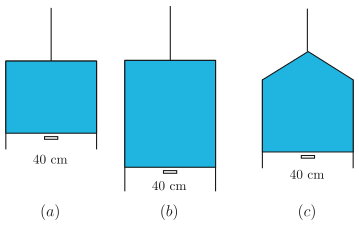
Start your 14-day free trial to unlock the full solution →The weight a liquid film can support equals the surface-tension force on its sliding wire, , which depends only on the surface tension and the length of the wire touching the film — not on the film's area, height or shape. All three arrangements share the same liquid, temperature and 40 cm wire, so all three support the same weight, N.
Concept
Surface tension is a force per unit length acting along any line in the surface of the film. A free liquid film has two surfaces (a front and a back), so along the sliding wire of length the film pulls up with a total force
This force balances the supported weight .
Why shape and area do not matter
The pulling force acts only along the line where the film meets the movable wire; it is set by the length of that contact line, not by how tall or wide the film is above it. Enlarging, shrinking or reshaping the film above the wire changes its area but leaves unchanged, so the supported weight is unchanged. (Also, an equilibrium film has uniform tension, so the extra triangular flap in (c) adds no extra pull on the wire.)
Steps
- From arrangement (a): with N and m. …
Unlock everything free for 14 days
- Full step-by-step solutions
- Concept-first explanations
- Methods, shortcuts & mistakes
- PYQ mapping + timed mock tests
Full access for 14 days. No credit card required.