Physics · Ch 9 — Mechanical Properties of Fluids
Speed of Efflux: Torricelli's Law
Speed of Efflux: Torricelli's Law
The Meaning of Efflux
Efflux simply means the outflow of a fluid from a container. Torricelli’s law gives the speed at which a liquid emerges from a small hole in an open tank. The remarkable result is that this speed is exactly the same as the speed a body would have if it fell freely from the surface of the liquid to the hole.
Setting Up the Problem
Consider a tank filled with a liquid of density . The tank has a small hole in its side at a height measured from the bottom. The free surface of the liquid is at a height above the bottom. The air above the liquid is at pressure . The hole is open to the atmosphere, so the pressure just outside the hole is the atmospheric pressure .
We apply the equation of continuity and Bernoulli’s equation to two points: point 1 at the hole and point 2 at the free surface.
Applying the Equation of Continuity
The equation of continuity for an incompressible fluid is , where is the cross-sectional area of the hole and is the cross-sectional area of the tank. This gives .
If the tank is very wide compared to the hole (), then the ratio is extremely small. Consequently, the speed of the liquid at the free surface, , is negligible compared to the speed at the hole, . We can therefore take for all practical purposes. This is a crucial simplification.
The condition is almost always true for a tank with a small hole. It means the liquid level drops very slowly, so the surface can be considered stationary during the outflow.
Applying Bernoulli’s Equation
Bernoulli’s equation for an ideal fluid (incompressible and non-viscous) flowing steadily is:
We now substitute the conditions at our two points:
- At the hole (point 1): The pressure is atmospheric, . The speed is , which is what we want to find. The height is .
- At the surface (point 2): The pressure is the pressure above the liquid, . The speed is . The height is .
Substituting these into Bernoulli’s equation gives:
Deriving the Speed of Efflux
Rearrange the equation to solve for :
Let , which is the vertical height of the liquid column above the hole. Multiplying both sides by gives the general formula for the speed of efflux:
General Speed of Efflux
This is the most general result. The speed depends on two factors: the gauge pressure () inside the container and the height of the liquid column.
Special Case 1: Pressurised Container ()
If the pressure inside the container is much larger than atmospheric pressure , and if this pressure difference is so large that the term is negligible in comparison, then the speed of efflux is determined almost entirely by the container pressure:
This situation is directly relevant to rocket propulsion. The fuel is burned in a combustion chamber at very high pressure, and the exhaust gases escape through a nozzle. The speed of the exhaust is primarily determined by the pressure difference, not by the height of the fuel column. …
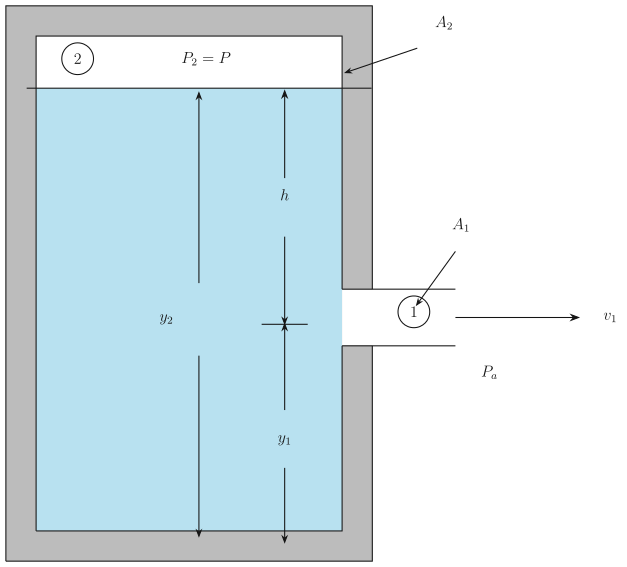
Drawn by us to help you understand the concept clearly, and verified to make sure it's accurate. For exams, practice from your textbook's own diagram.
Fig. 9.10 is a schematic of a liquid-filled tank with a small hole in its side. The tank is open to the atmosphere at the top, so the free surface (point 2) is at atmospheric pressure . The hole (point 1) is also open to the atmosphere, so the pressure there is also . The figure marks the vertical distances: is the height of the free surface above the hole, is the height of the hole above the base, and is the height of the free surface above the base. The cross-sectional area of the tank at the free surface is , and the area of the hole is , with .
The physical idea is that the liquid emerges from the hole with a speed that depends only on the depth of the hole below the free surface. This is Torricelli’s law. The figure is used to derive that law by applying Bernoulli’s equation between point 2 (the free surface) and point 1 (the hole). Because the hole is small, the speed of the free surface is negligible compared to (from the continuity equation, , so ). Both points are at atmospheric pressure, so the pressure terms cancel.
Here is the acceleration due to gravity, and is the vertical distance from the free surface down to the hole. The formula shows that the efflux speed is the same as the speed a body would acquire falling freely from rest through a height — a result that follows directly from the conservation of mechanical energy in an ideal fluid.
Torricelli’s law assumes the fluid is ideal (incompressible, non‑viscous) and the flow is steady. In real fluids, viscosity reduces the efflux speed, and the actual speed is slightly less than . The formula also assumes the hole is small enough that the free surface does not drop appreciably during the time of measurement. …