Physics · Ch 14 — Waves
The Speed of a Travelling Wave
The Speed of a Travelling Wave
The Speed of a Travelling Wave
When a wave travels through a medium, each particle of the medium oscillates about its mean position. The disturbance — the wave itself — moves forward at a definite speed. This speed is not the speed of the individual particles (which oscillate back and forth), but the speed at which the wave's shape (its phase) propagates.
Consider a wave travelling along a stretched string. If you pluck the string at one end, the kink travels to the other end. How fast does it travel? The answer depends on two properties of the string: how tight it is (the tension) and how heavy it is (the mass per unit length). Intuitively, a tighter string should transmit disturbances faster, and a heavier string should transmit them slower. We need to derive the exact relationship.
Deriving the Wave Speed on a String
Imagine a string under tension (in newtons), with linear mass density (mass per unit length, in kg/m). Suppose a wave pulse travels along the string to the right with speed . To analyse the forces, we shift our frame of reference: we ride along with the pulse, so that in this moving frame the pulse is stationary and the string flows past it to the left at speed .
Take a small element of the string of length that lies on the crest of the pulse. In the moving frame, this element is moving in a circular arc of radius . The string on either side of the element exerts tension forces tangent to the string at the ends of the element. These two tension forces are not exactly opposite — they have a small net inward component that provides the centripetal force needed to keep the element moving in its circular path.
Let the element subtend an angle at the centre of the circle (so the arc length is ). The two tension forces each have magnitude . Their horizontal components cancel, but their vertical components add. The net inward (radial) force is:
For a small element, is small, so . Thus:
The mass of the element is . In the moving frame, this mass moves in a circle of radius at speed , so the centripetal acceleration is . Newton's second law gives:
Substituting:
Cancel from both sides (provided ):
Therefore:
This is the speed of a transverse wave on a stretched string. The derivation assumes small amplitudes (so is small and the approximation holds) and an ideal flexible string.
The tension is the string tension, not the wave tension. It is measured in newtons. The linear mass density must be in kg/m. If you use g/cm, the answer will be off by a factor of 10.
The General Wave Speed Formula
The result above is a special case of a more general principle. For any mechanical wave, the speed depends on two factors: an elastic property (how strongly the medium resists deformation — the restoring force) and an inertial property (how much the medium resists changes in motion — the mass). The general form is:
For the string, the elastic property is the tension (the restoring force when the string is displaced), and the inertial property is the linear mass density .
For sound waves in a gas, the elastic property is the bulk modulus (resistance to compression) and the inertial property is the density :
For longitudinal waves in a solid rod, the elastic property is Young's modulus :
This pattern is universal for mechanical waves in continuous media.
Speed of a Transverse Wave on a String: Dimensional Check
We can verify the formula dimensionally. Tension has dimensions of force: . Linear mass density has dimensions . So:
Taking the square root gives , which is indeed the dimension of speed. The formula is dimensionally consistent.
If you ever forget the formula, dimensional analysis can recover it up to a dimensionless constant. The only combination of and that gives a speed is .
Dependence on Tension and Mass Density
The formula tells us two things directly:
-
Increasing tension increases wave speed. A tighter string transmits disturbances faster. This is why tightening a guitar string raises its pitch — the wave speed increases, so for a fixed string length, the fundamental frequency increases.
-
Increasing linear mass density decreases wave speed. A heavier string transmits disturbances slower. This is why the bass strings of a guitar are thicker (higher ) — they produce lower frequencies for the same tension.
The relationship is not linear: doubling the tension multiplies the speed by , not by 2. Quadrupling the tension doubles the speed.
Speed of a Longitudinal Wave in a Fluid
For sound waves (longitudinal waves) in a fluid (liquid or gas), the wave speed is:
where is the bulk modulus of the fluid and is its density. The bulk modulus measures how resistant the fluid is to compression:
where is the pressure change needed to produce a fractional volume change . The negative sign ensures is positive (since increasing pressure decreases volume).
For an ideal gas, the bulk modulus depends on the type of thermodynamic process. Sound waves propagate so rapidly that there is no time for heat exchange — the process is adiabatic. For an adiabatic process in an ideal gas:
where is the ratio of specific heats. From this, one can show that the adiabatic bulk modulus is . Therefore, the speed of sound in an ideal gas is:
Using the ideal gas law , we can write where is the molar mass. Substituting:
This shows that the speed of sound in a gas depends on:
- The nature of the gas (through and )
- The temperature (in kelvin)
- It does not depend on pressure (since pressure cancels out)
The speed of sound in air at (273 K) is about 331 m/s. At room temperature ( or 293 K), it is about 343 m/s. The increase is proportional to .
Speed of a Longitudinal Wave in a Solid …
Drawn by us to help you understand the concept clearly, and verified to make sure it's accurate. For exams, practice from your textbook's own diagram.
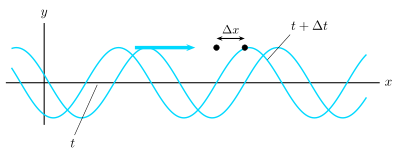
Fig. 14.8 is a snapshot of a harmonic wave at two different instants, overlaid on the same set of axes. The horizontal axis is position (in metres, say), and the vertical axis is the displacement of the medium's particles from their equilibrium positions. Two sine curves are drawn: one solid curve for the wave at time , and a second dashed (or lighter) curve for the same wave at a slightly later time .
The key visual is that the dashed curve is identical in shape to the solid curve, but shifted to the right along the -axis. A thick blue arrow above the curves indicates the direction of propagation — to the right. Two dots mark corresponding crests on the two curves: one crest on the curve and the same crest on the curve. A small double-headed arrow labelled connects these two crests horizontally, showing the distance the crest has moved in the time interval .
The physical idea is straightforward: a travelling wave does not stay put. Each feature of the wave — a crest, a trough, a zero-crossing — moves with a constant speed called the wave speed or phase speed. The figure makes this concrete by showing that the entire wave pattern slides rigidly to the right over time. The crest that was at some position at time is found at at time .
From this simple observation, the textbook derives the fundamental relation for wave speed. Since the crest moves a distance in time , the speed is
In the limit of infinitesimally small intervals, this becomes the instantaneous speed of any point of constant phase on the wave. For a harmonic wave described by , the argument is called the phase. To follow a fixed phase value (like the crest, where the sine equals 1), we set . Differentiating with respect to time gives
Thus the wave speed is . Using and , this becomes the familiar form
where is the frequency (in hertz) and is the wavelength (in metres). The figure therefore grounds the most important formula in wave motion: the speed of a wave equals the product of its frequency and wavelength. …