Computer Science · Ch 11 — Data Communication
Components of Data Communication
Components of Data Communication
The five essential components of any data communication system are the sender, receiver, message, communication medium, and protocol. These five pieces work together every time data moves from one device to another across a network.
Sender
A sender is any device capable of transmitting data over a network. This includes computers, mobile phones, smartwatches, walkie-talkies, video recording devices, and similar equipment. The sender is the source of the message.
Receiver
A receiver is any device capable of receiving data from the network. Examples include computers, printers, laptops, mobile phones, and televisions. In computer communication, both the sender and the receiver are referred to as nodes in the network.
Message
The message is the actual data or information that needs to be exchanged between the sender and the receiver. Messages can take many forms: text, numbers, images, audio, video, or multimedia.
Communication Medium
The communication medium is the path through which the message travels from the source to the destination. It is also called the medium or link. A medium can be either wired or wireless. Common examples include television cables, telephone cables, ethernet cables, satellite links, and microwaves. (Different types of communication media are studied in detail in section 11.5 of the textbook.)
Protocols …
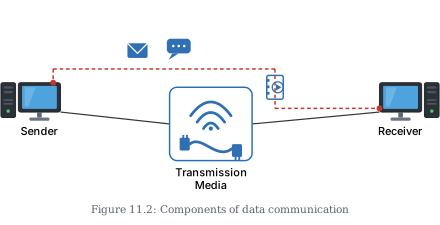
Drawn by us to help you understand the concept clearly, and verified to make sure it's accurate. For exams, practice from your textbook's own diagram.
Every act of data communication — whether it's an email, a chat message, or a video call — needs the same five ingredients: a Sender (where the message starts), a Receiver (where it's going), a Message (the actual content — shown here as an envelope, a chat bubble, and a video icon), Transmission Media (the physical path the message travels along, whether wired cable or wireless signal), and Protocol (the agreed rules both ends follow so the message can be understood). …