Physical Education · Ch 4 — Physical Education and Sports for CWSN (Children With Special Needs – Divyang)
Process of Divisioning
Process of Divisioning
Divisioning is carried out in three ordered steps — age, then gender, then ability.
1. Age. Athletes are first grouped by age. The age bands are different for team and for individual sports:
| Team Sports | Individual Sports |
|---|---|
| 15 & under | 8–11 years |
| 16–21 years | 12–15 years |
| 22 and above | 16–21 years |
| 22–29 years | |
| 30 and above |
2. Gender. The athletes are then grouped by gender, although in some circumstances genders may be combined.
3. Ability. Finally, athletes are grouped by their skill-ability scores, which the committee records through preliminary and on-site events.
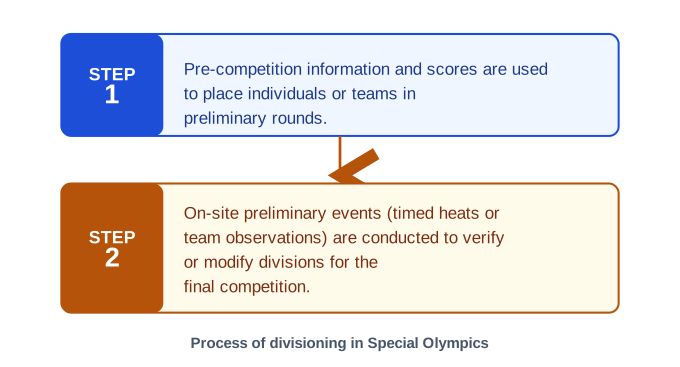
Before each competition, therefore, a time, score or skill assessment is submitted for each athlete or team. For events that are not timed or measured — such as football and badminton — a series of short games or a committee assessment is used instead. The divisions are then built so that each set of competitors is closely matched. The two-step flow below shows how pre-competition information and on-site events combine to set the final divisions.
Drawn by us to help you understand the concept clearly, and verified to make sure it's accurate. For exams, practice from your textbook's own diagram.
A two-box vertical process-flow diagram joined by a downward arrow. The top box reads: 'Pre-competition information and scores are used to place individuals or teams in preliminary rounds.' The bottom box reads: 'On-site preliminary events (timed heats or team observations) are conducted to verify or modify divisions for the final …
Maximum Effort Rule
To protect the fairness of this system there is a maximum effort rule: athletes are expected to give their best during the divisioning process, and coaches are expected to encourage them to do so. An athlete who does not take part honestly — holding back during the preliminary trials to be placed in a weaker division — violates the true spirit of competition and may even be disqualified.
A worked example, all three steps together. Consider a 14-year-old girl entering an individual bowling event. Step one places her in the 12–15 years individual-sport age band. Step two groups her with other female competitors in that band, unless organisers decide to combine genders for that particular division. Step three uses her submitted entry score, or a seeding round bowled on the day, to place her alongside bowlers of a similar skill level — so her division is both age-appropriate and genuinely competitive, rather than pitting a first-time bowler against a multi-year veteran of the same age and gender. …