Physical Education · Ch 10 — Training in Sports
Speed
Speed
Speed has a complex nature and depends heavily on the central nervous system. In sport it is the ability to perform motor movements — cyclic or acyclic — as quickly as possible.
Definitions
- Theiss and Schnabel: speed is the prerequisite to perform motor actions, under given conditions, in the minimum of time.
- Johnson and Nelson: the capacity of an individual to perform successive movements of the same pattern at a fast rate.
Speed is determined by several factors: the mobility of the nervous system, explosive strength, correct technique, bio-chemical reserves and metabolic power, flexibility, and psychic factors such as optimum arousal, attention, motivation, concentration and the ability to relax.
Types of Speed
Drawn by us to help you understand the concept clearly, and verified to make sure it's accurate. For exams, practice from your textbook's own diagram.
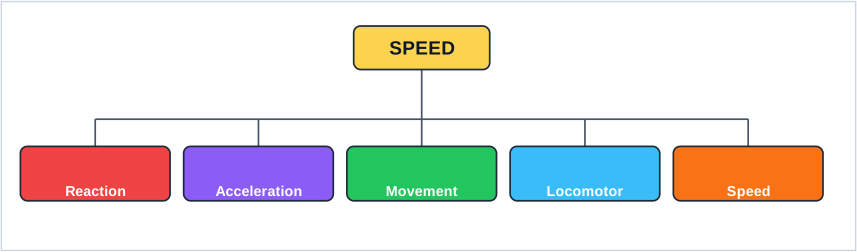
This chart lists the five recognised types of speed as five sibling boxes branching from a single 'SPEED' box at the top, read left to right: 'Reaction Ability', 'Acceleration Ability', 'Movement Speed', 'Locomotor Ability' and 'Speed Endurance'. They are drawn at the same level, with no hierarchy between them, because each is an independent, separately-trainable component of overall speed performance rather than a stage of the others — a sprinter, for example, needs reaction ability to leave the blocks quickly, acceleration ability to build up speed, and locomotor ability to hold that top speed over the rest of the race, all as distinct qualities. Reading the chart as a checklist rather than a sequence …
- Reaction Ability — the ability to react quickly to a stimulus or signal (visual, auditory or tactile). It depends on coordinative abilities and can be simple or complex.
- Acceleration Ability — the ability to reach a high speed from a stationary position; it depends greatly on explosive strength, technique and movement frequency, and is vital in sprinting.
- Movement Speed — the ability to complete a single movement in the minimum possible time; mainly relevant to acyclic sports and dependent on technique and explosive strength.
- Locomotor Ability — the ability to maintain maximum speed, while in motion, for the maximum possible distance or duration, as in the 100 m and 200 m sprints; it depends heavily on nervous-system mobility and is relatively hard to improve.
- Speed Endurance — the ability to move at high speed for a longer duration, i.e. under fatigue; it depends on anaerobic capacity, technique and psychic factors.
Methods to Develop Speed
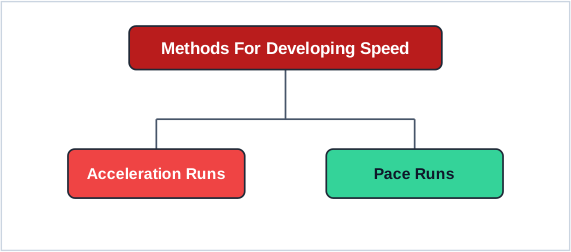
Speed depends on both genetic and environmental factors. The ratio of fast-twitch to slow-twitch muscle fibres (which sets the natural limit on speed) cannot be changed, but the environmental side can still be trained. The two most common methods are:
Drawn by us to help you understand the concept clearly, and verified to make sure it's accurate. For exams, practice from your textbook's own diagram.
This chart shows the two standard methods used to train speed, branching from a single 'Methods For Developing Speed' box into 'Acceleration Runs' and 'Pace Runs'. The two boxes sit side by side, not one after another, because they develop two different aspects of speed and suit different events — acceleration runs (described in the numbered point just below the figure) build the ability to reach top speed quickly from a stationary start, which matters most for short sprints, while pace runs build the ability to hold a controlled, even speed over a longer distance, which matters most for middle- and long-distance events of 800 m and above. …
- Acceleration Runs — used to develop the ability to reach maximum speed from a static position. The athlete runs a set distance, trying to gain full momentum as early as possible, with sufficient rest between runs. A sprinter usually needs about 50-60 m to reach top speed, and even well-trained athletes can hold that top speed for only about 20 m. Typically 6-12 repetitions with complete recovery, always after a proper warm-up.
- Pace Runs — running a set distance at a uniform speed, used mainly for races of 800 m and above. Since full speed can be held only for around 300 m, longer races need energy to be conserved by holding a steady pace throughout. For training, the athlete runs at a maximum steady speed over a distance 10-20% more than the actual racing distance, with complete recovery between repetitions fixed to the athlete's fitness. …