Biology · Ch 4 — Principles of Inheritance and Variation
Mendel's Laws of Inheritance
Mendel's Laws of Inheritance
Mendel’s Experiments: The Foundation
Gregor Mendel spent seven years (1856–1863) performing hybridisation experiments on garden peas. His work marked the first time statistical analysis and mathematical logic were applied to biology. Because he worked with a large number of plants (a large sampling size), his data carried greater credibility. He also confirmed his inferences by studying successive generations, proving his results pointed to general rules of inheritance — not just unsubstantiated ideas.
Mendel chose the garden pea because it showed clear, opposing traits: tall or dwarf plants, yellow or green seeds, and so on. This allowed him to set up a basic framework of rules that later scientists expanded to account for all the complexity seen in nature.
True-Breeding Lines and Contrasting Traits
A true-breeding line is one that, after continuous self-pollination, shows stable inheritance and expression of a trait for several generations. Mendel selected 14 true-breeding pea plant varieties, pairing them so that each pair was similar except for one character with contrasting traits.
The seven pairs of contrasting traits Mendel studied were:
| Character | Contrasting Traits |
|---|---|
| Stem height | Tall / dwarf |
| Flower colour | Violet / white |
| Flower position | Axial / terminal |
| Pod shape | Inflated / constricted |
| Pod colour | Green / yellow |
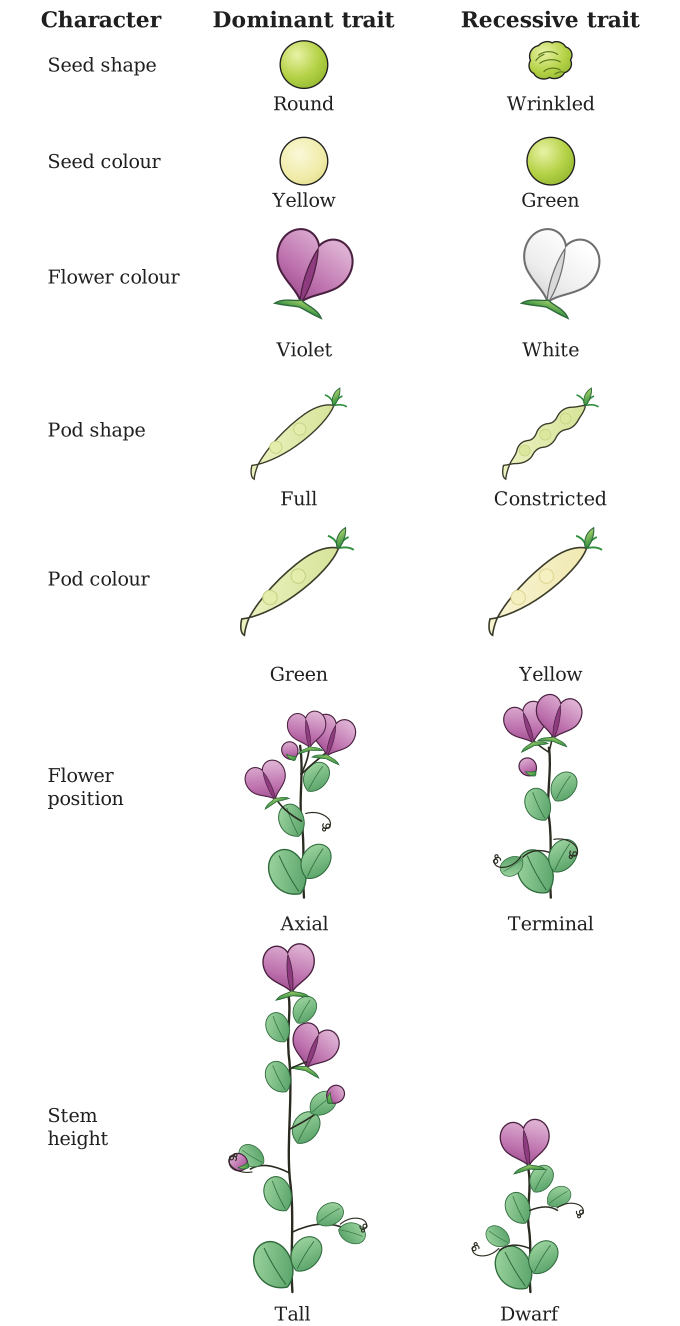
Drawn by us to help you understand the concept clearly, and verified to make sure it's accurate. For exams, practice from your textbook's own diagram.
Figure 4.1 is a simple but powerful visual summary of the seven pairs of contrasting traits that Mendel chose to study in the garden pea (Pisum sativum). The figure is laid out as a plate showing each of the seven characters, with the two contrasting forms (the "traits") depicted side by side for easy comparison.
For stem height, the plate shows a tall plant next to a dwarf plant. The tall plant is drawn with a long, upright stem, while the dwarf plant is short and stubby. For flower colour, one flower is shown as violet (or purple) and the other as white. For flower position, one flower is shown growing along the main stem (axial) and the other at the tip of the stem (terminal). For pod shape, one pod is drawn as full and inflated, the other as pinched and constricted between the seeds. For pod colour, one pod is coloured green and the other yellow. For seed shape, one seed is drawn as round and smooth, the other as wrinkled. Finally, for seed colour, one seed is yellow and the other green. …