Question of 90
Q.Give the structure of a typical pollen grain and its pre- and post-pollination changes.
Odisha ChseOdisha CHSE +2 Science Board Exam 2019Subjective· 7mImportance★★★★★
0% · 0/90 Questions
You're viewing a preview — the full solution, concept, methods & PYQ mapping are locked.
Start your 14-day free trial to unlock the full solution →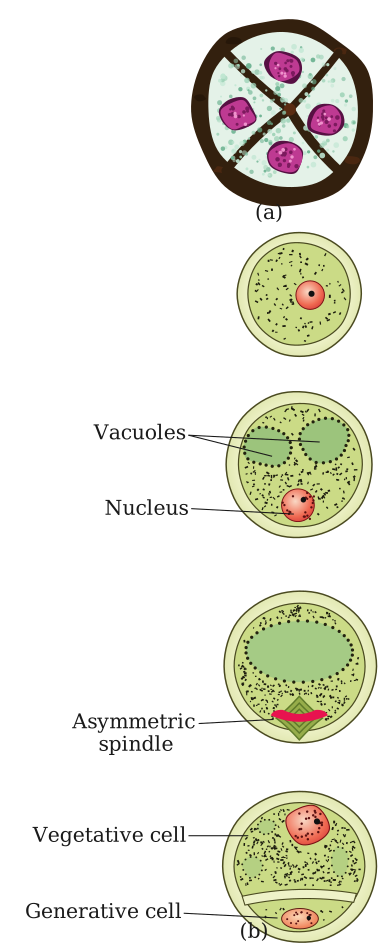
A pollen grain is a two-walled, generally two-celled (vegetative + generative cell) structure; before pollination it develops inside the anther by microsporogenesis, and after pollination it germinates on the stigma to form a pollen tube that carries the male gametes to the ovule for double fertilization.
Structure of a typical pollen grain
Pollen grains are generally spherical, about 25-50 micrometres in diameter, and have a well-protected two-layered wall:
- Exine: the hard, tough outer wall made of sporopollenin, one of the most resistant organic materials known - it can withstand high temperatures, strong acids/alkalis, and enzymatic degradation, which is why pollen exine is well preserved as fossils. The exine has prominent apertures called germ pores, thin areas where sporopollenin is absent, through which the pollen tube will later emerge; its surface often has an ornamented pattern (used to identify plant species, e.g., in the study of palynology, useful in allergy research and forensic science).
- Intine: the thin, continuous inner wall made of cellulose and pectin, lying just internal to the exine.
- At the time of shedding, the pollen grain's cytoplasm typically has two cells: a large vegetative (tube) cell with abundant food reserves and an irregular nucleus, and a small generative cell floating in the cytoplasm of the vegetative cell. In about 60% of angiosperm species, the generative cell divides mitotically before shedding to produce two male gametes, so the pollen is shed in a 3-celled stage; in the remaining species it divides later, inside the pollen tube.
Pre-pollination changes (development of pollen)
- Inside the anther, diploid microspore mother cells (pollen mother cells) within the microsporangium undergo meiosis (microsporogenesis) to produce a tetrad of four haploid microspores.
- Microspores mature into pollen grains; each undergoes pollen mitosis I, an asymmetric mitotic division producing the vegetative cell and generative cell described above.
- The pollen wall (exine/intine) develops and, in many species, pollen mitosis II occurs at this stage, producing two male gametes before the pollen is shed.
- The mature pollen grains dehydrate somewhat to withstand desiccation during transport, and the anther eventually dehisces, releasing the pollen for pollination (transfer to the stigma).
Post-pollination changes (germination and fertilization)
- Once a compatible pollen grain lands on a receptive stigma, it absorbs water and nutrients from the stigma surface and germinates, putting out a pollen tube through one of the germ pores. …
Unlock everything free for 14 days
- Full step-by-step solutions
- Concept-first explanations
- Methods, shortcuts & mistakes
- PYQ mapping + timed mock tests
Full access for 14 days. No credit card required.