Q.Draw a neat diagram of megasporangium of an angiosperm and label any six parts.
You're viewing a preview — the full solution, concept, methods & PYQ mapping are locked.
Start your 14-day free trial to unlock the full solution →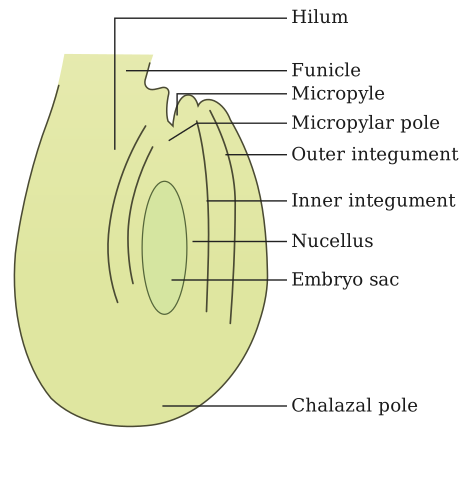
The megasporangium in angiosperms is the ovule, a protective structure within the ovary that contains the nucellus and eventually develops into a seed after fertilization.
In angiosperms, the term megasporangium refers to the ovule, which is the structure where megaspores are formed and where the female gametophyte, also known as the embryo sac, develops. This ovule is housed within the ovary of the flower and is crucial for sexual reproduction, as it ultimately develops into a seed after successful fertilization. Understanding its structure is fundamental to comprehending plant reproduction.
The ovule is a small, oval-shaped structure typically attached to the placenta inside the ovary by a stalk called the funiculus. The point where the funiculus attaches to the main body of the ovule is known as the hilum, which represents the junction between the ovule and the funiculus.
The main body of the ovule consists of a mass of parenchymatous cells called the nucellus. The nucellus is rich in reserve food material and provides nourishment to the developing megaspore and subsequently to the embryo sac. Protecting the nucellus are one or two protective envelopes called integuments. These integuments encircle the nucellus almost completely, leaving a small opening at one end called the micropyle. The micropyle is a critical pore that facilitates the entry of the pollen tube into the ovule during fertilization.
Opposite the micropylar end is the chalaza, which represents the basal part of the ovule. It is from the chalazal end that the integuments originate. Within the nucellus, usually towards the micropylar end, a single megaspore mother cell differentiates. This cell undergoes meiosis to produce megaspores, one of which develops into the female gametophyte or embryo sac. The mature embryo sac contains the egg cell, which is ready for fertilization. …
Unlock everything free for 14 days
- Full step-by-step solutions
- Concept-first explanations
- Methods, shortcuts & mistakes
- PYQ mapping + timed mock tests
Full access for 14 days. No credit card required.