Chemistry · Ch 7 — Alcohols, Phenols and Ethers
Chemical Reactions
Chemical Reactions
Of all the functional groups covered so far in this chapter, the ether linkage is the least reactive — which is exactly why ethers are so widely used as inert solvents. What little chemistry they do undergo falls into two categories: breaking the C–O bond itself, and electrophilic attack on an aromatic ring carrying an ether oxygen.
1. Cleavage of the C–O bond in ethers
Splitting the C–O bond needs fairly drastic conditions — an excess of a hydrogen halide, usually at elevated temperature. A simple dialkyl ether, treated with excess HX, is broken down completely into two molecules of alkyl halide, because the alcohol formed in the first step is itself attacked by more HX:
Reactivity of the hydrogen halides toward this cleavage runs , so in practice the reaction is carried out with concentrated HI or HBr at high temperature; HCl is too weak an acid and too poor a nucleophile source to cleave an ether efficiently.
An alkyl aryl ether behaves differently: the bond that breaks is always the alkyl–oxygen bond, never the aryl–oxygen bond, because the aryl–oxygen bond is the more stable of the two. The products are a phenol and an alkyl halide:
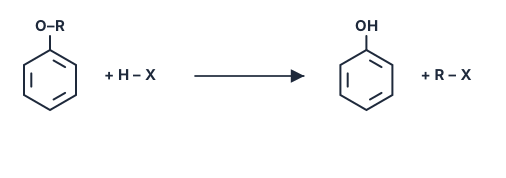
Drawn by us to help you understand the concept clearly, and verified to make sure it's accurate. For exams, practice from your textbook's own diagram.
Redrawn from the NCERT page with the structures, printed labels (O – R, O–R, OH) and reagent placement exactly as the …
A mixed dialkyl ether with two different alkyl groups, , likewise cleaves to give one alkyl halide and one alcohol:
Mechanism.
Step 1: The reaction of an ether with concentrated HI starts with protonation of the ether molecule — the ether oxygen is protonated to give an oxonium ion.
Step 2: Iodide is a good nucleophile — it attacks this oxonium ion at the less hindered (least substituted) carbon by an pathway, displacing an alcohol and forming the alkyl halide.
When the two alkyl groups on the ether are both primary or secondary, it is therefore the smaller/lower alkyl group that ends up as the halide, while the bulkier group is released as the alcohol. If HX is in excess and the mixture is kept hot, that liberated alcohol is itself converted to the corresponding alkyl halide by a second, ordinary substitution with HX.
Step 3:
When one of the two alkyl groups is tertiary, the outcome changes: protonation of the ether is followed by slow, spontaneous loss of the other (non-tertiary) group as an alcohol, because this step generates a relatively stable tertiary carbocation. The halide ion then captures this carbocation rapidly. The mechanism has therefore switched from to , and the halide product is the tertiary alkyl halide rather than the smaller group.
For an alkyl aryl ether such as anisole (methyl phenyl ether), protonation gives a methylphenyloxonium ion, . Of the two C–O bonds radiating from that oxygen, the O–CH bond is weaker than the O–CH bond, because the ring carbon attached to oxygen is -hybridised and the aryl–oxygen bond carries some partial double-bond character (from delocalisation of an oxygen lone pair into the ring). Iodide ion therefore attacks the methyl carbon and cleaves the O–CH bond, giving methyl iodide and phenol. Phenol does not react any further to give a halide, because the carbon of the aromatic ring cannot undergo the nucleophilic substitution that halide formation would require.
2. Electrophilic substitution on the aromatic ring
In an alkyl aryl ether, the alkoxy group (–OR) attached to the ring is an ortho, para director and activates the ring toward electrophilic attack, for essentially the same reason a phenolic –OH does: a lone pair on the ether oxygen delocalises into the ring, building up extra electron density specifically at the ortho and para positions (shown by the corresponding set of resonance structures for the ring–OR system).
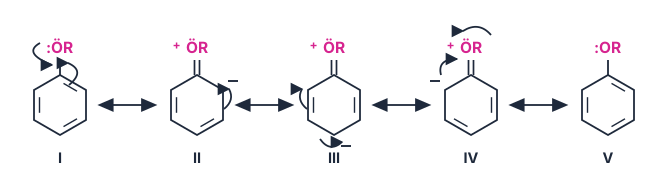
Drawn by us to help you understand the concept clearly, and verified to make sure it's accurate. For exams, practice from your textbook's own diagram.
Redrawn from the NCERT page with the structures, printed labels (:OR, I, +ÖR, II, III, IV, V) and reagent placement exactly as th …
This makes such rings noticeably more reactive toward electrophiles than benzene itself. …
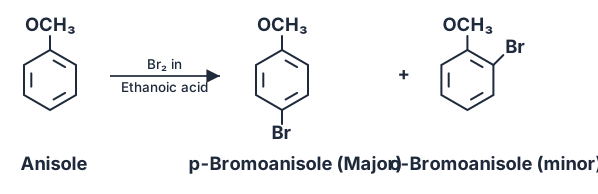
Drawn by us to help you understand the concept clearly, and verified to make sure it's accurate. For exams, practice from your textbook's own diagram.
Redrawn from the NCERT page with the structures, printed labels (OCH3, Br) and reagent placement exactly as the t …
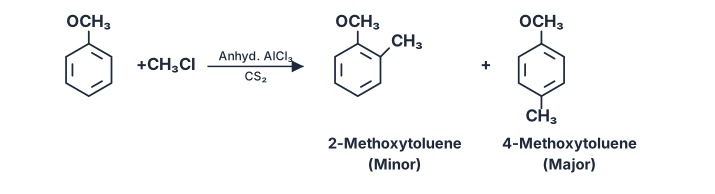
Drawn by us to help you understand the concept clearly, and verified to make sure it's accurate. For exams, practice from your textbook's own diagram.
Redrawn from the NCERT page with the structures, printed labels (OCH3, CH3) and reagent placement exactly as the …
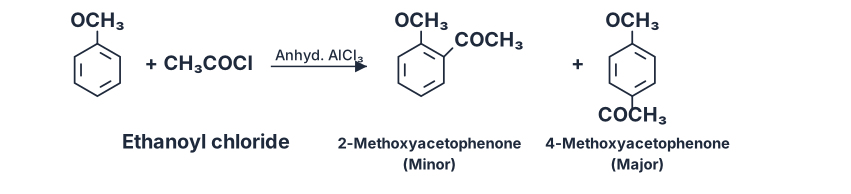
Drawn by us to help you understand the concept clearly, and verified to make sure it's accurate. For exams, practice from your textbook's own diagram.
Redrawn from the NCERT page with the structures, printed labels (OCH3, COCH3) and reagent placement exactly as the …
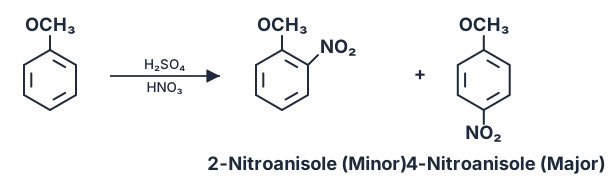
Drawn by us to help you understand the concept clearly, and verified to make sure it's accurate. For exams, practice from your textbook's own diagram.
Redrawn from the NCERT page with the structures, printed labels (OCH3, NO2) and reagent placement exactly as the …