Electrophilic Aromatic Substitution – The First Meeting
Imagine you have a benzene ring — that perfect, flat hexagon of six carbons with alternating double bonds. It's stable, almost stubbornly so. You want to attach something new to it, say a bromine atom or a nitro group. But benzene doesn't react like an alkene. It doesn't just add across a double bond. Instead, it does something more elegant: it kicks out a hydrogen and keeps its aromatic ring intact.
That's the heart of Electrophilic Aromatic Substitution (EAS).
The Intuition: Why "Substitution" and Not "Addition"?
Benzene's stability comes from its delocalised π electrons — a cloud above and below the ring. This cloud is electron-rich, so it attracts electrophiles (electron-loving species). But if an electrophile simply added to a double bond, the ring would break its aromaticity, losing that huge stabilisation. That would be energetically costly.
So benzene does something smarter: it lets the electrophile attack, temporarily breaks aromaticity to form a high-energy intermediate (the arenium ion), and then loses a proton to restore the aromatic ring. The net result? A hydrogen is replaced by the electrophile. The ring is back to its stable, aromatic self.
Note
The key trade-off: temporary loss of aromaticity is acceptable because the final product regains it. Addition reactions would permanently destroy aromaticity — benzene avoids that.
The Precise Statement
Electrophilic Aromatic Substitution is a reaction in which an electrophile (E+) replaces a hydrogen atom on an aromatic ring, proceeding through a sigma complex (arenium ion) intermediate, and restoring aromaticity after deprotonation.
The general equation:
Ar−H+EX+Ar−E+HX+
where Ar represents an aromatic ring.
The Mechanism in Three Steps
Generation of the electrophile – Many EAS reactions need a catalyst to create a strong enough E+. For example, bromination uses FeBrX3 to polarise BrX2 into BrX+.
Attack by the aromatic ring – The π electrons of benzene attack the electrophile, forming a sigma complex (also called the arenium ion or Wheland intermediate). This intermediate is non-aromatic — it has four π electrons delocalised over five carbons, and one sp3 carbon bearing the electrophile and a hydrogen.
Benzene+E+⟶Sigma complex (non-aromatic)
Deprotonation – A base (often the counterion of the catalyst, like FeBrX4X−) removes the proton from the sp3 carbon. The pair of electrons from the C–H bond flows back into the ring, restoring the aromatic sextet.
Sigma complex+Base⟶Product+HX+
Watch out
The sigma complex is not aromatic. It's a high-energy intermediate. Students often mistakenly think it's still aromatic — it isn't. That's why the step is fast and the complex is short-lived.
Why This Matters for Exams
EAS is the gateway to understanding how to put groups onto benzene rings. The rate-determining step is usually the formation of the sigma complex (step 2). The regiochemistry (where the electrophile goes) depends on whether the ring already has a substituent — that's the topic of activating/deactivating groups and ortho/para vs. meta directors. …
Why this formula?
Electrophilic Addition Reactions: Why the Mechanism Works
Electrophilic addition is a cornerstone of alkene and alkyne chemistry. Instead of memorising the "arrow pushing," let's understand why the reaction proceeds the way it does — driven by electron density, stability, and charge.
1. The Core Idea: Why Alkenes React This Way
Alkenes have a π-bond — a cloud of electrons above and below the plane of the σ-bond. This π-electron cloud is:
Electron-rich (nucleophilic)
Exposed (not shielded by σ-bonds like in alkanes)
An electrophile (electron-lover) is attracted to this high electron density. The reaction is electrophilic addition because the electrophile attacks first.
Key principle: The π-bond acts as a Lewis base (electron donor). The electrophile is a Lewis acid (electron acceptor).
2. The General Mechanism (Two-Step)
Step 1: Formation of a Carbocation (or Bridged Intermediate)
The electrophile (E⁺) attacks the π-bond. The π-electrons form a new σ-bond to E⁺, leaving the other carbon with a positive charge — a carbocation.
C=C+EX+⟶CX+−C−E
Why does this happen?
The π-bond is weaker than a σ-bond (~260 kJ/mol vs ~350 kJ/mol). Breaking the π-bond to form a σ-bond is energetically favourable because the new σ-bond is stronger. The carbocation is a high-energy intermediate, but it's stabilised by:
Hyperconjugation (alkyl groups donate electron density)
Inductive effect (alkyl groups push electrons toward the positive carbon)
Step 2: Nucleophilic Attack
A nucleophile (Nu⁻) attacks the carbocation, forming a second σ-bond.
CX+−C−E+NuX−⟶C−Nu−C−E
Why does this happen?
The carbocation is electron-deficient (positive charge). The nucleophile is electron-rich. Opposite charges attract — this is electrostatic and orbital overlap driven.
3. The Key "Formula" — Markovnikov's Rule
Statement: In the addition of HX to an unsymmetrical alkene, the hydrogen attaches to the carbon with more hydrogens already, and the X attaches to the carbon with fewer hydrogens.
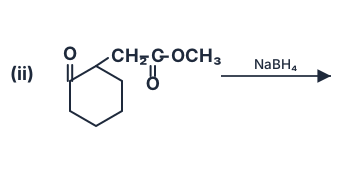
(i) is Markovnikov hydration of an alkene; (ii) and (iii) are NaBH4 reductions. NaBH4 is a mild hydride donor that reduces the carbonyl of an aldehyde or ketone to an alcohol but is not strong enough to reduce an ester.
Concept and steps
In acid-catalysed hydration, H+ adds to give the more stable (more substituted) carbocation, so -OH ends up on the more substituted carbon (Markovnikov). Propene gives a secondary carbocation on C-2, so the product is propan-2-ol, CH3-CH(OH)-CH3.
NaBH4 delivers hydride to the electrophilic carbonyl carbon. The molecule has two carbonyls: a ring ketone (C=O) and an ester (-CO-OCH3). NaBH4 reduces only the ketone, converting the ring C=O into -CH(OH)- (a secondary alcohol), while the ester group survives. The product is a cyclohexane ring bearing -OH on the former carbonyl carbon and -CH2-CO-OCH3 on the adjacent carbon, i.e. methyl (2-hydroxycyclohexyl)acetate. …
Method: Chemoselectivity-Prediction Method for Hydration and Hydride-Reduction Reactions
Core Concept
Predicting the product of an addition or reduction reaction requires first identifying WHICH functional group(s) the reagent can react with, then applying the correct regiochemical/selectivity rule to that group while leaving unreactive functional groups untouched.
Steps
Identify every functional group present in the substrate (alkene, ketone, aldehyde, ester, etc.).
Identify what the given reagent is capable of reacting with: dilute acid + H2O reacts with C=C (hydration); NaBH4 is a mild hydride donor that reduces aldehydes and ketones but is NOT strong enough to reduce esters, carboxylic acids, or amides.
For an addition to an unsymmetrical alkene under acid catalysis, apply Markovnikov's rule: protonate to form the more stable (more substituted) carbocation, then let water attack that same carbon, so -OH lands on the more substituted carbon.
For a substrate with multiple carbonyls, identify which specific carbonyl(s) the reagent can reduce (aldehyde/ketone) versus which it must leave alone (ester), and reduce only the reactive one(s).
Write the final structure showing the changed group(s) explicitly and confirm all unreactive groups are drawn unchanged.
Applying this:
(i) CH3-CH=CH2 + H2O/H+: protonation gives the secondary carbocation at C-2; water attacks there -> propan-2-ol, CH3-CH(OH)-CH3. …