Chemistry · Ch 8 — Aldehydes, Ketones and Carboxylic Acids
Methods of Preparation of Carboxylic Acids
Methods of Preparation of Carboxylic Acids
Overview
Carboxylic acids can be built up from several different starting functional groups — alcohols, aldehydes, aromatic side chains, nitriles, amides, esters, Grignard reagents, and acyl derivatives. Most of these routes are oxidations (alcohols/aldehydes, alkylbenzenes) or hydrolyses (nitriles, amides, esters, acyl halides, anhydrides); one route (Grignard + ) is a carbon-chain-extending addition. Two of these — reaction of a Grignard reagent with , and hydrolysis of a nitrile — are especially valuable synthetically because they convert an alkyl halide into a carboxylic acid having one carbon atom more than the halide, i.e., they let a chemist "climb" the homologous series by a single carbon.
1. From Primary Alcohols and Aldehydes
Primary alcohols are readily oxidised all the way to carboxylic acids using common oxidising agents:
- Potassium permanganate, , works in neutral, acidic, or alkaline medium.
- Potassium dichromate, , and chromium trioxide, , work in acidic medium — the combination is commonly called the Jones reagent.
Since the alcohol is first oxidised to the aldehyde and then to the acid, aldehydes themselves are also oxidised further to carboxylic acids — even mild oxidising agents (such as Tollens' reagent, discussed with aldehyde reactions) can carry out this last step, taking the aldehyde on to the corresponding acid.
Both the oxidation of a 1° alcohol and the oxidation of an aldehyde converge on the same carboxylic acid, because the aldehyde is simply the intermediate oxidation stage between the alcohol and the acid.
2. From Alkylbenzenes
Aromatic carboxylic acids are obtained by vigorous oxidation of the alkyl side chain on a benzene ring, using hot chromic acid or acidic/alkaline potassium permanganate.
The key feature of this method is that the entire side chain is oxidised away down to a single carboxyl group directly attached to the ring, no matter how long the side chain is — a one-carbon methyl substituent and a three-carbon propyl substituent both end up as on oxidation.
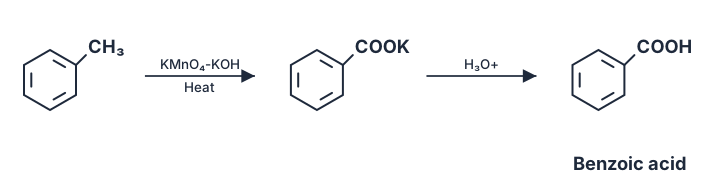
Drawn by us to help you understand the concept clearly, and verified to make sure it's accurate. For exams, practice from your textbook's own diagram.
Redrawn from the NCERT page with the structures, printed labels (CH3, COOK, COOH) and reagent placement exactly as the textbook prints them. Every element of this display was checked against the printed page during the sweep's blind-judge verification pass, so wha …
In each case the ring is oxidised to give the potassium salt
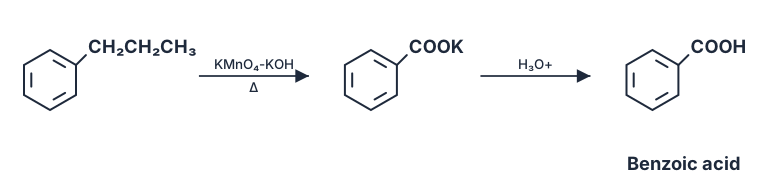
Drawn by us to help you understand the concept clearly, and verified to make sure it's accurate. For exams, practice from your textbook's own diagram.
Redrawn from the NCERT page with the structures, printed labels (CH2CH2CH3, COOK, COOH) and reagent placement exactly as the textbook prints them. Every element of this display was checked against the printed page during the sweep's blind-judge verification pass, so wh …
of the acid first, which then needs a separate acidification step () to liberate the free carboxylic acid.
Which alkyl groups are oxidised: primary and secondary alkyl substituents on the ring are both oxidised to under these conditions, but a tertiary alkyl group is not affected — it has no benzylic hydrogen for the oxidant to attack, so the ring survives with the tertiary group intact.
Suitably substituted alkenes can also be oxidised with the same reagents to give carboxylic acids (as with cyclohexene, illustrated further below), so this oxidative strategy is not limited strictly to aromatic rings.
3. From Nitriles and Amides
Nitriles () are hydrolysed stepwise: first to the corresponding amide, and then further to the carboxylic acid
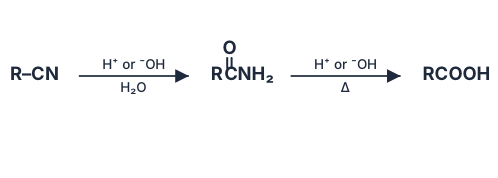
Drawn by us to help you understand the concept clearly, and verified to make sure it's accurate. For exams, practice from your textbook's own diagram.
Redrawn from the NCERT page with the structures, printed labels (R, C, NH2) and reagent placement exactly as the textbook prints them. Every element of this display was checked against the printed page during the sweep's blind-judge verification pass, so what …
, using either acid () or base () as catalyst in aqueous medium. If the conditions are kept mild, the reaction can be halted at the amide stage; more vigorous/prolonged hydrolysis (typically with heating) carries it through to the acid.
This nitrile route is one of the two "chain-extending" methods mentioned in the overview: since nitriles are themselves prepared from alkyl halides by reaction with , hydrolysing the resulting nitrile gives an acid with one carbon more than the starting alkyl halide — a useful way to ascend the homologous series.
From Amides
Amides are hydrolysed directly to carboxylic acids under either acidic or basic catalysis, releasing ammonia (or an ammonium/amine salt, depending on conditions) as the other product.
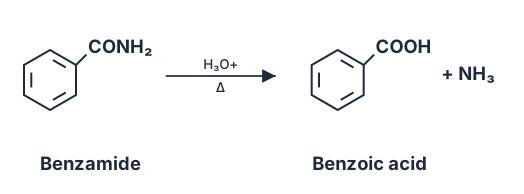
Drawn by us to help you understand the concept clearly, and verified to make sure it's accurate. For exams, practice from your textbook's own diagram.
Redrawn from the NCERT page with the structures, printed labels (CONH2, COOH) and reagent placement exactly as the textbook prints them. Every element of this display was checked against the printed page during the sweep's blind-judge verification pass, so wha …
This is exactly the second stage of the nitrile-hydrolysis pathway above, run to completion under forcing (heated, acidic) conditions rather than stopped partway.
4. From Grignard Reagents
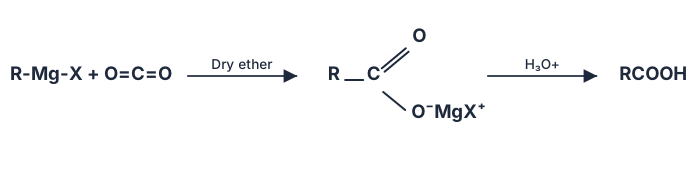
Grignard reagents add to carbon dioxide (conveniently used as dry ice) in dry ether to form the magnesium salt of a carboxylic acid; acidifying this salt with a mineral acid
Drawn by us to help you understand the concept clearly, and verified to make sure it's accurate. For exams, practice from your textbook's own diagram.
Redrawn from the NCERT page with the structures, printed labels () and reagent placement exactly as the textbook prints them. Every element of this display was checked against the printed page during the sweep's blind-judge verification pass, so what …
then liberates the free carboxylic acid.
Because the Grignard reagent's carbon becomes bonded directly to the carbonyl carbon supplied by , the product acid has one carbon atom more than the alkyl/aryl group of the Grignard reagent. Since Grignard reagents are themselves made from alkyl (or aryl) halides, this — together with the nitrile route above — is the second standard way to convert a halide into an acid with one additional carbon, ascending the homologous series by exactly one carbon each time.
A representative application (converting an aryl bromide to the corresponding acid) proceeds through the Grignard reagent and its carboxylate salt before final acidification:
5. From Acyl Halides and Anhydrides
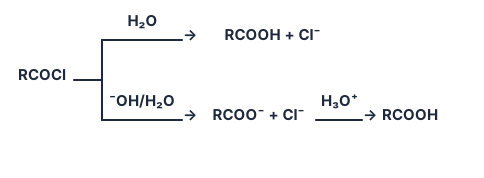
Acyl (acid) halides:
- Simple hydrolysis with water converts an acyl halide to the carboxylic acid directly.
- Hydrolysis is even more facile with aqueous base, which gives the carboxylate ion; this is then acidified to obtain the carboxylic acid.
Drawn by us to help you understand the concept clearly, and verified to make sure it's accurate. For exams, practice from your textbook's own diagram.
Redrawn from the NCERT page with the structures, printed labels () and reagent placement exactly as the textbook prints them. Every element of this display was checked against the printed page during the sweep's blind-judge verification pass, so what …
Acid anhydrides are hydrolysed by water to give the corresponding carboxylic acid(s) directly. A symmetrical anhydride gives two molecules of the same acid, whereas a mixed anhydride gives two different acids:
6. From Esters
Esters can be hydrolysed by either route, and the two routes behave differently:
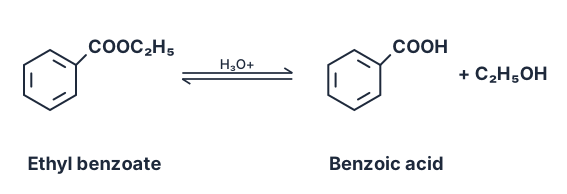
- Acidic hydrolysis is an equilibrium process and gives the carboxylic acid directly, along with the alcohol.
- Basic hydrolysis (saponification) goes essentially to completion and gives the carboxylate salt, not the free acid; a subsequent acidification step
Drawn by us to help you understand the concept clearly, and verified to make sure it's accurate. For exams, practice from your textbook's own diagram.
Redrawn from the NCERT page with the structures, printed labels (COOC2H5, COOH) and reagent placement exactly as the textbook prints them. Every element of this display was checked against the printed page during the sweep's blind-judge verification pass, so wha …
is needed to liberate the carboxylic acid from its salt. …