Chemistry · Ch 9 — Amines
Reduction of Nitro Compounds
Reduction of Nitro Compounds
Reduction of Nitro Compounds
The most direct route to a primary amine is to start from the corresponding nitro compound and simply reduce the group down to . This works for both aromatic nitro compounds (nitrobenzene and its derivatives) and aliphatic nitroalkanes — the reduction chemistry is the same in either case.
Two practical ways of carrying out this reduction are used.
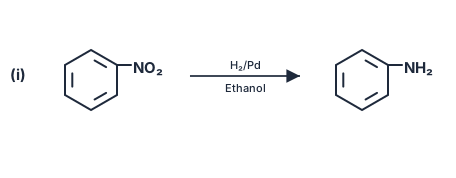
Catalytic hydrogenation
Hydrogen gas is passed over the nitro compound in the presence of a finely divided hydrogenation catalyst — nickel, palladium, or platinum:
Drawn by us to help you understand the concept clearly, and verified to make sure it's accurate. For exams, practice from your textbook's own diagram.
Redrawn from the NCERT page with the structures, printed labels (NO2, NH2) and reagent placement exactly as the textbook prints them. Every element of this display was checked against the printed page during the sweep's blind-judge verification pass, so what …
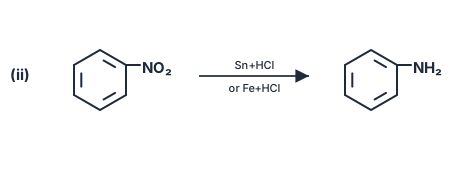
Reduction with metal and acid
Alternatively, the nitro compound is reduced with a metal in acidic medium — tin with hydrochloric acid, or iron with hydrochloric acid:
Drawn by us to help you understand the concept clearly, and verified to make sure it's accurate. For exams, practice from your textbook's own diagram.
Redrawn from the NCERT page with the structures, printed labels (NO2, NH2) and reagent placement exactly as the textbook prints them. Every element of this display was checked against the printed page during the sweep's blind-judge verification pass, so what …
…