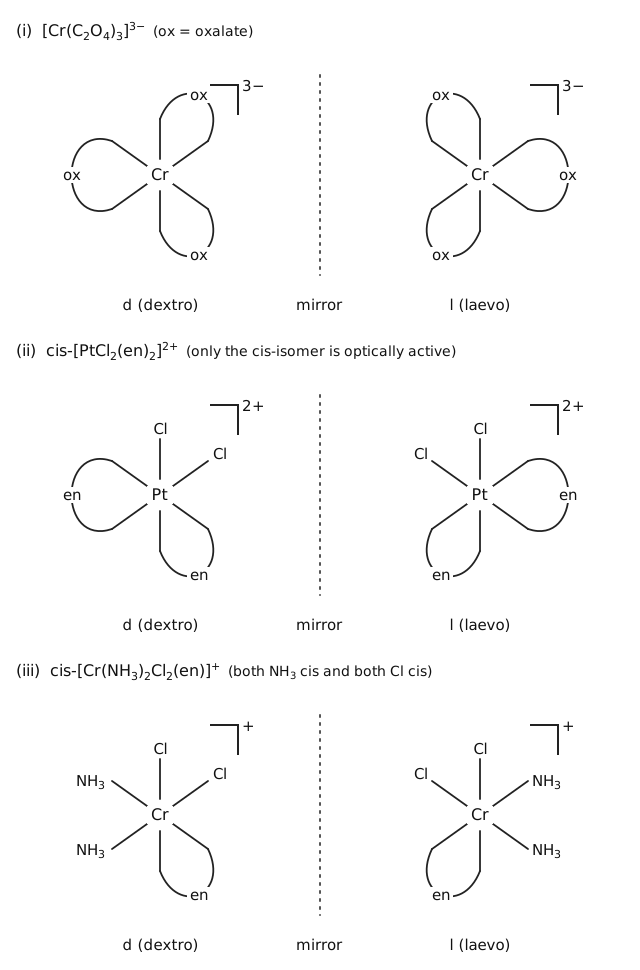
Q.Draw the structures of optical isomers of:
You're viewing a preview — the full solution, concept, methods & PYQ mapping are locked.
Start your 14-day free trial to unlock the full solution →
Optical isomers (enantiomers) are non-superimposable mirror images that arise when a complex lacks an improper axis of rotation (). For the given complexes, we draw the enantiomer pairs: (i) has a D₃ geometry with two chiral forms;
(ii) is cis (chiral) and trans (achiral);
(iii) has two chiral cis isomers and one achiral trans isomer.
Concept and Intuition
Optical isomerism in coordination compounds is a geometric property: a molecule is chiral if it cannot be superimposed on its mirror image. The key condition is the absence of any improper rotation axis (), which includes planes of symmetry () and centers of inversion (). For octahedral complexes, chirality often arises when:
- The complex has bidentate ligands (like oxalate or ethylenediamine ) that create a helical twist.
- The arrangement of monodentate ligands around the metal is asymmetric enough to break all symmetry planes.
A common shortcut: if a complex has no plane of symmetry, it is almost certainly chiral. But be careful — some complexes with planes can still be chiral if the plane is not a symmetry plane of the whole molecule (e.g., a plane that cuts through a ligand but not the metal center in a symmetric way).
A common mistake is to assume that any complex with bidentate ligands is automatically chiral. For example, is chiral, but in the trans form is achiral because it has a plane of symmetry. Always check for symmetry planes.
Let’s work through each complex step by step.
(i)
Step 1: Identify the coordination geometry.
Chromium(III) is , octahedral. Each oxalate ion () is a bidentate ligand, so three oxalates occupy all six coordination sites. The complex is analogous to .
Step 2: Visualize the structure.
Each oxalate forms a five-membered chelate ring with the metal. The three rings are arranged around the metal in a propeller-like shape. Imagine the three oxalate planes — they are not coplanar; they twist to minimize steric clash. This twist gives the complex a handedness: a left-handed propeller (Λ) and a right-handed propeller (Δ).
Step 3: Check for symmetry.
Does the complex have any plane of symmetry? No — if you try to reflect it, the chelate rings swap positions in a way that cannot be superimposed. The complex belongs to the point group (a threefold rotation axis through the metal, perpendicular to the plane of the three oxalates, with three perpendicular axes, but no mirror plane and no centre of inversion). Since contains no improper symmetry element (, , or ) at all, the complex is chiral.
A quick test: if a complex has three identical bidentate ligands in an octahedral arrangement, it is always chiral — like a three-bladed propeller. The two enantiomers are called Λ (left-handed) and Δ (right-handed).
Step 4: Draw the enantiomers.
We represent the octahedron as a perspective drawing. For Λ, the three oxalate rings form a left-handed helix when viewed along the axis. For Δ, the helix is right-handed.
Λ-[Cr(C₂O₄)₃]³⁻          Δ-[Cr(C₂O₄)₃]³⁻
   (left-handed)            (right-handed)
(Imagine the oxalate ligands as curved arcs connecting adjacent vertices of the octahedron.)
(ii)
Step 1: Identify the metal and geometry.
Platinum(IV) is , octahedral. Ethylenediamine () is a bidentate ligand, so two ligands occupy four coordination sites. The remaining two sites are occupied by chloride ions.
Step 2: Consider possible geometric isomers.
With two bidentate ligands and two monodentate ligands, there are two geometric arrangements:
- cis: the two chlorides are adjacent (90° apart).
- trans: the two chlorides are opposite (180° apart).
Step 3: Check chirality of each.
- trans isomer: The two ligands lie in a plane, and the two chlorides are opposite. This complex has a plane of symmetry that passes through the metal, the two chlorides, and bisects the ligands. It also has a center of inversion at the metal. So it is achiral — no optical isomers.
- cis isomer: The two chlorides are adjacent. The ligands are now forced into a non-planar arrangement. Does this complex have any plane of symmetry? If you try to find a plane, you’ll see that the two rings are oriented perpendicular to each other, and the chlorides break any symmetry. The complex is chiral — it exists as a pair of enantiomers.
Many students mistakenly think the cis isomer of is achiral because they imagine the ligands as flat. But is flexible and puckered; in the cis arrangement, the two chelate rings are not coplanar, destroying all symmetry planes.
Step 4: Draw the enantiomers for the cis form.
We show the two chlorides at adjacent positions. The two ligands are drawn as arcs connecting the remaining four vertices. The enantiomers are mirror images.
cis-[PtCl₂(en)₂]²⁺ (enantiomer 1)    cis-[PtCl₂(en)₂]²⁺ (enantiomer 2)
   Cl at positions 1,2                    Cl at positions 1,2
   en rings twist one way                en rings twist opposite way
(For the trans isomer, simply draw the two chlorides opposite, and the two ligands in a plane — no mirror image needed.)
(iii)
Step 1: Identify the geometry and ligands. …
Unlock everything free for 14 days
- Full step-by-step solutions
- Concept-first explanations
- Methods, shortcuts & mistakes
- PYQ mapping + timed mock tests
Full access for 14 days. No credit card required.