Chemistry · Ch 6 — Haloalkanes and Haloarenes
Physical Properties
Physical Properties
Physical State
Pure haloalkanes and haloarenes are colourless. Exposure to light, however, causes bromo- and iodo-compounds to develop colour over time as traces of the free halogen are liberated. Several of the lower, more volatile members carry a distinctly sweet smell.
Not every low-molecular-mass halide is a liquid. , , and some chlorofluoromethanes are gases under normal room conditions — the halogen substitution alone isn't enough to hold these small, light molecules in the liquid state at everyday temperature. From there upward the homologous series is made up of liquids, and the very heavy members are solids.
Melting and Boiling Points
Carbon–halogen bonds are polar, so haloalkane and haloarene molecules carry a permanent dipole. Compared with the hydrocarbon they are derived from, a halide also has a distinctly higher molecular mass. Both effects combine — the added dipole-dipole attraction plus stronger van der Waals interaction from the heavier, more polarisable halogen — so a haloalkane's intermolecular pull is consistently greater than that of the parent hydrocarbon of similar size. This is why chloro-, bromo- and iodoalkanes boil well above hydrocarbons of comparable molecular mass.
Chain length. Within one homologous series, adding units increases the electron count and the surface area available for van der Waals contact, so boiling point climbs steadily as the carbon chain gets longer.
Halogen identity. For a fixed alkyl group, boiling point rises down the halogen group:
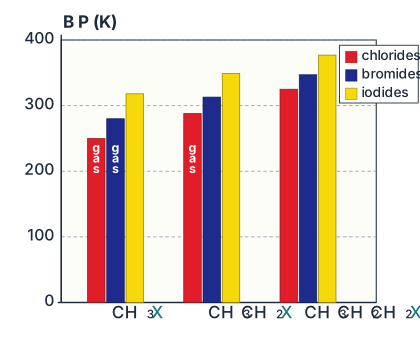
A bigger, more easily polarised halogen atom sets up stronger van der Waals attraction between molecules, so the boiling point order tracks the halogen's size and mass rather than its electronegativity. (This comparison across the series , and is summarised graphically in Fig. 6.1 in the textbook — chlorides sit lowest, bromides in the middle, iodides highest, at every chain length shown.)
Drawn by us to help you understand the concept clearly, and verified to make sure it's accurate. For exams, practice from your textbook's own diagram.
The figure is a bar chart with the horizontal axis () showing three alkyl groups: methyl (), ethyl (), and propyl (). For each alkyl group, three vertical bars are drawn side by side, representing the chloride, bromide, and iodide derivatives. The vertical axis () is boiling point in Kelvin (B.P./K), ranging from 0 to 400 K.
Within each alkyl group, the bars increase in height from left to right: chloride < bromide < iodide. This shows that for the same alkyl chain, boiling point rises as the halogen atom becomes larger and heavier. Across the three groups, the bars for a given halogen (e.g., all chlorides) also increase as the alkyl chain lengthens from methyl to ethyl to propyl. The bars for methyl chloride, methyl bromide and ethyl chloride are specifically marked as 'gas', indicating that these three compounds are gases at room temperature (around 298 K), while all others are liquids or solids.
The physical idea taught is that boiling point depends on the strength of intermolecular forces — primarily van der Waals forces (London dispersion forces) and dipole-dipole interactions. Larger halogen atoms have more electrons and greater polarizability, leading to stronger temporary dipoles and stronger van der Waals attractions. Similarly, longer alkyl chains have more surface area and more electrons, also increasing van der Waals forces. The trend is:
The key formula the textbook develops from this figure is the order of boiling points for alkyl halides with the same alkyl group:
More precisely, the magnitude of van der Waals forces increases with the number of electrons and the polarizability of the molecule. For a given alkyl group , the boiling point order is: …
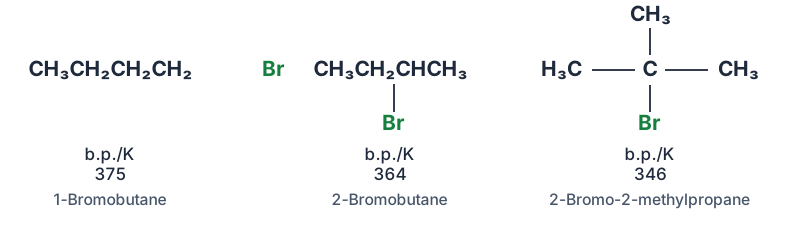
Branching (isomer effect). Among isomeric haloalkanes, boiling point falls as branching increases. A straight-chain isomer presents more surface area to neighbouring molecules than a compact, branched one, so its van der Waals attractions are stronger and it boils higher; the most branched isomer, being closest to spherical, has the least surface contact and therefore the lowest boiling point. For the three isomeric bromobutanes this gives:
| Isomer | Structure | b.p. |
|---|---|---|
| 1-bromobutane (straight chain) | ||
| 2-bromobutane (one branch) | ||
| 2-bromo-2-methylpropane (most branched) |
The fully branched tertiary halide, 2-bromo-2-methylpropane, has the lowest boiling point of the three, consistent with it having the smallest exposed surface area.
Drawn by us to help you understand the concept clearly, and verified to make sure it's accurate. For exams, practice from your textbook's own diagram.
The real NCERT page prints all three of these isomeric bromobutanes side by side as condensed formulas to make one point: boiling point falls as branching increases. 1-Bromobutane (straight chain, 375 K) boils highest; 2-bromobutane (one branch, 364 K) is next; 2-bromo-2-methylpropane (tert-butyl bromide, the most branched, 346 K) has the lowest boiling point of the three -- branching lowers a molecule's surface …
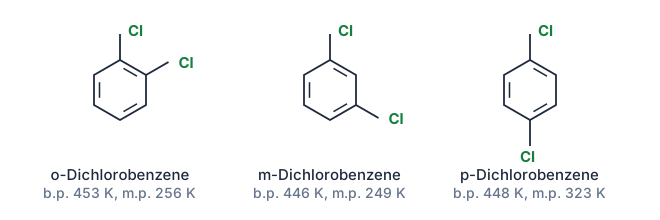
Dihalobenzenes. Isomeric dihalobenzenes (-, - and -) boil at nearly identical temperatures, since boiling point depends mainly on the strength of intermolecular attraction in the liquid, which changes little with the position of the two halogens on the ring. Melting point behaves differently: the -isomer melts distinctly higher than its - and -counterparts. Its symmetrical shape allows the molecules to pack more efficiently into a crystal lattice, so more energy (a higher temperature) is needed to break that ordered solid-state arrangement.
Drawn by us to help you understand the concept clearly, and verified to make sure it's accurate. For exams, practice from your textbook's own diagram.
The three dichlorobenzene isomers boil at nearly identical temperatures (453/446/448 K) -- boiling point depends mainly on liquid-state intermolecular attraction, which barely changes with where the two chlorines sit. Melting point tells a different story: the symmetric para isomer packs far more efficiently into a crystal lattice, so i …
Density
Bromo- and iodo-alkanes, along with polychlorinated compounds, are all denser than water. Density rises as the number of carbon atoms increases, as the number of halogen atoms on the molecule increases, and as the atomic mass of the halogen present increases — heavier, more numerous halogen atoms add proportionally more mass than volume. This trend is why, for instance, moving from a mono- to a dichloro- to a trichloro- to a tetrachloro- derivative of methane raises the density step by step, and why the polyhalogen compounds among these are markedly denser than water.
| Compound | Density (g/mL) | Compound | Density (g/mL) |
|---|---|---|---|
| n- | 0.89 | 1.336 | |
| n- | 1.335 | 1.489 |