Mathematics · Ch 10 — Vector Algebra
Section Formula
Section Formula
10.5.3 Section Formula
The Core Problem
Two points and have position vectors and . A point on the line joining and has position vector . We find when divides the segment in a given ratio — either internally ( between and ) or externally ( on the extension beyond or beyond ).
The ratio is always taken with and as positive scalars. For internal division, corresponds to segment and to segment .
Case I: Internal Division
When lies between and , it divides internally in the ratio :
Derivation of the Position Vector
Since and are collinear and point in the same direction with magnitudes in the ratio :
This is the section formula for internal division.
The coefficient of is (the ratio for segment ) and the coefficient of is (the ratio for ). Mnemonic: the ratio "opposite" to a point goes with that point.
Case II: External Division
When lies on the extension of (beyond or beyond ), it divides externally in the ratio :
Note the denominator is , not , and is outside the segment .
Derivation of the Position Vector
Here and point in the same direction, giving:
This is the section formula for external division.
To remember it: take the internal formula and change the plus in the denominator to a minus, and the plus in the numerator to a minus. (Equivalently, .)
Special Case: The Midpoint
When is the midpoint of , the ratio becomes . Substituting into the internal formula:
…
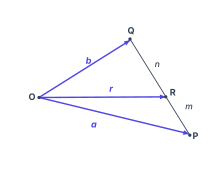
Drawn by us to help you understand the concept clearly, and verified to make sure it's accurate. For exams, practice from your textbook's own diagram.
What Fig 10.16 Shows
The diagram is a clean vector sketch with three labelled points — O, P, Q, and R — and the origin O placed somewhere off to the side. From O, three position vectors radiate: to point P, to point Q, and to point R. The points P and Q are joined by a thin slate-coloured line segment, and R lies on that segment between P and Q. Along the segment, two distances are marked: the length QR is labelled , and the length RP is labelled . So R divides the segment PQ internally in the ratio , meaning that the distance from R to P is parts and from R to Q is parts.
The figure has no axes — it is a freehand vector diagram, not a coordinate plot. Its purpose is purely geometric: to show how the position vector of a point dividing a line segment can be expressed in terms of the endpoints' position vectors.
The Physical Idea
When you have two points P and Q in space, any point R on the line joining them can be described by how far it is from P relative to the whole segment. If R lies between P and Q, we say it divides the segment internally. The ratio tells you that if you travel from P to Q, you cover units to reach R, then more units to reach Q — or equivalently, .
The key insight is that the position vector of R is a weighted average of and , with the weights being the opposite segment lengths. This is not obvious at first glance, which is why the textbook derives it using triangle law of vector addition.
The Derivation (in brief)
From the diagram, using triangle OQR:
But is along the direction from Q to P, and its magnitude is times the unit vector along QP. Similarly, from triangle OPR:
Since and are in opposite directions along the same line, and the total vector from P to Q is , we can write:
Substituting either into the triangle law gives the same result.
This is the internal division formula. Every symbol:
- — position vector of the dividing point R
- — position vector of P (first endpoint)
- — position vector of Q (second endpoint)
- — the part of the segment from R to P (the "near" part to P)
- — the part from R to Q (the "near" part to Q)
A common mistake is to swap the weights. Notice that the coefficient of is , not , and the coefficient of is . The weight attached to an endpoint's position vector is the opposite segment length — the part of the segment that is farther from that endpoint.
Special Case: Midpoint
When , R is the midpoint of PQ. The formula simplifies to:
This is the simplest and most frequently used special case — the midpoint's position vector is just the average of the two endpoints' position vectors. …
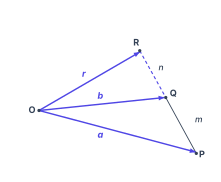
Drawn by us to help you understand the concept clearly, and verified to make sure it's accurate. For exams, practice from your textbook's own diagram.
What Fig. 10.17 Shows
The figure illustrates the external division of a line segment by a third point . Three position vectors emanate from the origin : (to point ), (to point ), and (to point ). The three points , , and lie on a straight line, but with a crucial ordering: lies beyond , so the collinear arrangement is –– (read from left to right along the line). The segment is drawn as a dashed indigo line, and the segment is solid. Along , two lengths are marked: and , where corresponds to the length and corresponds to .
The physical idea is simple: when a point divides a segment externally, it does not lie between the two endpoints. Instead, it lies on the extension of the segment beyond one of them. Here, is beyond , so lies between and . The ratio of division is given as , which is the ratio of the whole segment from to to the segment from to .
A common mistake is to confuse the ratio with the distances and directly. In external division, the ratio is taken as , not or . The point is outside the segment , so the distances involved are from to and from to , not from to .
The Key Formula
The textbook leaves the derivation as an exercise, but the result is central. For two points and with position vectors and respectively, the position vector of the point that divides externally in the ratio (meaning ) is:
Here:
- = position vector of (from origin )
- = position vector of
- and are positive scalars representing the ratio
- = position vector of
Notice the minus sign in the numerator and denominator — this is the hallmark of external division. Compare with the internal division formula , where both terms are added. The external formula can be remembered as "the vector of the point beyond which lies (, since is beyond ) gets the positive coefficient , and the other vector () gets subtracted."
A quick way to derive the external formula: treat external division as internal division with a negative ratio. If divides externally in the ratio , you can think of it as dividing internally in the ratio . Substituting in the internal formula gives .