Physics · Ch 13 — Nuclei
Nuclear Force
Nuclear Force
The Need for a New Force
The electrons in an atom are held by the familiar Coulomb force between opposite charges. But the nucleus is a different world. Inside it, positively charged protons are packed into a volume roughly a femtometre across. The Coulomb repulsion between them is enormous — at such close range, it would blow any nucleus apart instantly if only electromagnetic forces were at work. Yet nuclei are stable. The binding energy per nucleon is about 8 MeV for medium-mass nuclei, which is millions of times larger than the binding energy of an electron in an atom. This tells us that a completely different kind of force — far stronger than anything we encounter in atomic physics — must be acting between nucleons (protons and neutrons). This is the nuclear force.
The nuclear force must be strong enough to overcome the Coulomb repulsion between protons, and it must act on both protons and neutrons alike. It also has to be short-ranged, because the binding energy per nucleon stays roughly constant as nuclei get larger — a behaviour that would be impossible if every nucleon interacted with every other nucleon over long distances.
The gravitational force between two protons is about times weaker than the Coulomb force. It plays no role whatsoever inside the nucleus. The nuclear force is the dominant player.
Properties of the Nuclear Force
Experiments carried out between 1930 and 1950 revealed several key properties of the nuclear force. They are listed below, each with a full explanation.
(i) The nuclear force is much stronger than the Coulomb force (and far stronger than gravity)
This is the most fundamental property. Inside a nucleus, two protons are separated by a distance of the order of a few femtometres. The Coulomb repulsive force between them is
At , this force is about — an enormous force for such tiny particles. If only the Coulomb force existed, the protons would fly apart. The nuclear attractive force must be stronger than this to hold the nucleus together. In fact, the nuclear force is roughly 100 times stronger than the electromagnetic force at these distances. The gravitational force between two protons at the same separation is
which is utterly negligible compared to the nuclear force.
Do not confuse "stronger" with "longer range". The nuclear force is stronger but acts only over a very short distance. The Coulomb force, though weaker, has infinite range. This is why, in a large nucleus, protons on opposite sides still repel each other electrically, but the nuclear force only acts between nearest neighbours.
(ii) The nuclear force is short-ranged — it falls to zero beyond a few femtometres
This is the property that explains why the binding energy per nucleon is roughly constant for medium and large nuclei. If the nuclear force had infinite range, each nucleon would attract every other nucleon in the nucleus, and the binding energy per nucleon would increase with the number of nucleons. Instead, the force saturates: a nucleon only feels the attraction of its immediate neighbours, not of nucleons far away.
The potential energy between two nucleons as a function of their separation is shown schematically in Figure 13.2 of the textbook. The key features are:
- At a separation , the potential energy is minimum. This is the equilibrium separation.
- For , the force is attractive — the potential energy increases as increases (the slope is positive, so the force is negative, i.e., attractive).
- For , the force becomes strongly repulsive — the potential energy rises very steeply as the nucleons are pushed closer together. This repulsive core prevents the nucleons from collapsing into each other.
The existence of a repulsive core at very short distances is crucial. Without it, the strong attraction would cause the nucleus to collapse to a point. The repulsive core provides a "hard core" that keeps nucleons at a minimum distance.
A rough sketch of the potential energy curve looks like this:
| Separation | Nature of force | Behaviour of potential |
|---|---|---|
| Strongly repulsive | rises steeply (positive, large) | |
| Zero (equilibrium) | is minimum (most negative) | |
| Attractive | increases (becomes less negative) | |
| Essentially zero |
The force is not described by a simple inverse-square law like Coulomb's law or Newton's law of gravitation. There is no single, simple mathematical formula for the nuclear force. Various models (Yukawa potential, Lennard-Jones type potentials) are used to approximate it, but none is exact.
The short range of the nuclear force is the reason why the binding energy per nucleon is roughly constant (about 8 MeV) for nuclei with mass number . Each nucleon only interacts with its nearest neighbours, so adding more nucleons does not increase the binding energy per nucleon — it just adds more "surface" and "volume" effects that roughly balance out.
(iii) The nuclear force is charge-independent — it is the same between any pair of nucleons …
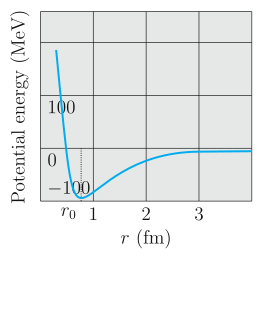
Drawn by us to help you understand the concept clearly, and verified to make sure it's accurate. For exams, practice from your textbook's own diagram.
The figure is a graph of potential energy (in MeV) on the vertical axis against separation distance (in femtometres, fm) on the horizontal axis. The curve itself tells the story of the nuclear force in a single picture.
At very small separations — below about fm — the potential energy is large and positive, rising steeply toward MeV. This is the strong repulsive core of the nuclear force: if two nucleons are pushed too close together, they experience a violent push apart. The curve crosses zero near fm and then plunges downward into a deep negative well, reaching a minimum of about MeV at fm. This minimum is the equilibrium separation — the distance at which the pair is most tightly bound. For , the curve rises gently back toward zero, meaning the force is attractive (the nucleons want to pull together) but weakens rapidly, becoming negligible beyond a few fm. A dashed vertical line at marks the boundary: left of it is the repulsive region, right of it the attractive region.
Do not confuse this potential-energy curve with the Coulomb potential. The Coulomb force between two protons is repulsive and follows — it never turns attractive. The nuclear force has a completely different shape: a deep well with a hard repulsive core, and it cuts off to zero beyond a few fm.
The physical idea is that the nuclear force is short-range and saturates. Because the force dies away within a few fm, a nucleon inside a large nucleus only feels the pull of its nearest neighbours — not all nucleons in the nucleus. This saturation explains why the binding energy per nucleon is roughly constant (about MeV) for medium and large nuclei, rather than growing with the number of nucleons.
The textbook does not give a single formula for the nuclear force — it explicitly states that unlike Coulomb's law or Newton's law of gravitation, there is no simple mathematical form for the nuclear force. However, the figure is used to introduce the key idea that the force can be described by a potential well with a minimum at . The relevant relation is the definition of force from potential energy:
where is the potential energy of the nucleon pair and is the force between them. The sign of the slope tells you the direction of the force:
- Where the curve is falling (negative slope), is positive — repulsive.
- Where the curve is rising (positive slope), is negative — attractive.
- At the minimum (), the slope is zero, so the net force is zero — that is the equilibrium separation. …