Physics · Ch 10 — Wave Optics
Refraction at a Rarer Medium
Refraction at a Rarer Medium
Refraction at a Rarer Medium
When a plane wave travels from a denser medium into a rarer medium, the wave speed increases (). This change in speed causes the wavefront to bend away from the normal. As a result, the angle of refraction () is greater than the angle of incidence ().
The construction of the refracted wavefront follows the same Huygens principle used for refraction into a denser medium. The secondary wavelets in the rarer medium travel faster, so the refracted wavefront tilts away from the normal.
Snell's Law and the Critical Angle
Even though the wave bends away from the normal, Snell's law still holds:
Here:
- = refractive index of the denser medium (incident side)
- = refractive index of the rarer medium (refracted side)
- = angle of incidence
- = angle of refraction
Since , we have , so .
As increases, increases faster. There is a special angle of incidence, called the critical angle (), for which the angle of refraction becomes exactly (). Setting in Snell's law gives:
This is the defining equation for the critical angle.
Total Internal Reflection
- If , then — the refracted wave just grazes the boundary. …
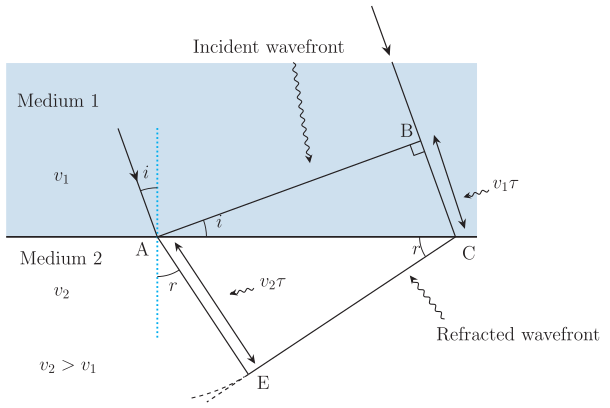
Drawn by us to help you understand the concept clearly, and verified to make sure it's accurate. For exams, practice from your textbook's own diagram.
What the Figure Shows
The diagram depicts a plane wavefront AB traveling in medium 1 (denser, with wave speed ) and striking the interface PP′ at an angle of incidence . The interface is horizontal, with a dashed normal line perpendicular to it. Medium 2 below the interface is rarer, meaning its wave speed is greater than . The incident wavefront reaches point A first, then point B later. By the time B touches the interface, the secondary wavelet from A has already traveled a distance into medium 2, where is the time taken for B to reach the interface. The refracted wavefront CE is drawn as the common tangent to all such secondary wavelets from points along the interface. The angle of refraction is measured between the refracted wavefront and the interface (or equivalently between the refracted ray and the normal). The figure clearly shows that , so the wavefront bends away from the normal.
Physical Idea
When a wave enters a rarer medium, its speed increases (). This causes the wavefront to spread out more on the rarer side. The construction using Huygens’ principle shows that the refracted wavefront is tilted such that the angle it makes with the interface is larger than the incident angle. This bending away from the normal is the opposite of what happens when going from rarer to denser medium. The key consequence is that for a sufficiently large incident angle, the refracted wavefront can become parallel to the interface (), and beyond that, no refraction occurs — leading to total internal reflection.
Key Formula Developed
From the geometry of the figure, the ratio of the sines of the angles is related to the wave speeds:
Using the definition of refractive index (where is the speed of light in vacuum), this becomes Snell’s law:
Here:
- = refractive index of medium 1 (denser)
- = refractive index of medium 2 (rarer) …