Exercise 8.6 · Q1
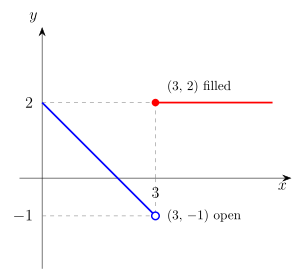
Q.Study the graph given below: the graph shows a decreasing straight line for that approaches an open (unfilled) circle at the point (this value is not attained), and for a horizontal ray at starting with a filled dot at .
(i) What y-value is the function approaching as approaches 3 from the left?
(ii) What y-value is the function approaching as approaches 3 from the right?
(iii) What (if any) is the actual y-value at ? What can you conclude about the function?
Puducherry CbseNCERTSubjective· 3mImportance★★★★★est
60% · 12/20 Questions
✓ Free question
Read the one-sided limits straight off the described graph and compare them with the actual function value at to test continuity.
is continuous at iff all three of the following are equal: the left-hand limit, the right-hand limit, and itself.
- (i) Left-hand limit (). For the graph is a decreasing straight line heading toward the open (unfilled) circle at — the curve gets arbitrarily close to as approaches from the left, even though that exact point is not part of the graph.
- (ii) Right-hand limit (). For the graph is the horizontal ray , starting at the filled dot . As approaches from the right, the function value stays at .
- (iii) Actual value at and conclusion. The filled dot at tells us the function is defined at , with
Compare the two one-sided limits:
Since the left- and right-hand limits disagree, the two-sided limit does not exist. Because continuity at a point requires the two-sided limit to exist and equal , and here it fails at the very first condition, has a jump discontinuity at — despite being a perfectly defined value.
- Self-check. A jump discontinuity is exactly this pattern: the graph "teleports" from one -level (here , unattained) to another (here , attained) at the break point — consistent with an open circle on one branch and a filled dot on the other.
✓Final answer
(i) . (ii) . (iii) , but the one-sided limits differ (), so does not exist and is discontinuous at (a jump discontinuity).
Unlock everything free for 14 days
- Full step-by-step solutions
- Concept-first explanations
- Methods, shortcuts & mistakes
- PYQ mapping + timed mock tests
Full access for 14 days. No credit card required.