Business Studies · Ch 4 — Business Services
Warehousing
Warehousing
Storage has always been vital to economic development. The warehouse was originally a static unit for keeping and storing goods scientifically and systematically, so as to preserve their original quality, value and usefulness. Typically it received merchandise by rail, truck or bullock cart, and items were moved manually and hand-piled in stacks on the floor. Warehouses are used by manufacturers, importers, exporters, wholesalers, transport businesses, customs and others.
- Today, warehouses have ceased to be mere storage units and have become logistical service providers in a cost-efficient manner — making available the right quantity, at the right place, at the right time, in the right physical form, at the right cost.
- Modern warehouses are automated with conveyors, computer-operated cranes and forklifts, and use logistics-automation software for warehouse management.
Types of Warehouses
- Private warehouses — owned, operated or leased by a company for its own goods (e.g., retail chain stores, multi-brand/multi-product companies), planned around a material-handling system for maximum efficiency. Benefits: control, flexibility and improved dealer relations.
- Public warehouses — used to store goods by traders, manufacturers or any member of the public for a fee. The government regulates them by issuing licences to private parties. The warehouse owner acts as an agent of the goods' owner, is responsible for their safety, and offers facilities such as transport by rail and road. Convenient for small manufacturers who cannot afford their own warehouses. Benefits: flexibility of locations, no fixed cost, and value-added services like packaging and labelling.
- Bonded warehouses — licensed by the government to accept imported goods before payment of tax and customs duty. Importers cannot remove goods from the docks/airport until the duty is paid; meanwhile the goods are kept here by the customs authorities and are said to be "in bond." They have facilities for branding, packaging, grading and blending, and buyers may inspect and repackage goods. Advantages: goods can be removed in part, duty paid in instalments, funds need not be blocked before goods are sold/used, and goods can even be re-exported without paying customs duty — thus facilitating entrepot trade.
- Government warehouses — fully owned and managed by the government through public-sector organisations such as the Food Corporation of India, State Trading Corporation and Central Warehousing Corporation.
- Cooperative warehouses — set up by marketing or agricultural cooperative societies for the members of their society.
Functions of Warehousing
- Consolidation — the warehouse receives and consolidates goods from different production plants and dispatches them to a particular customer in a single shipment.
- Break the bulk — it divides bulk quantities received from plants into smaller quantities, transported to clients as required.
- Stock piling — seasonal storage of goods not immediately needed for sale or manufacture, released as demand arises; especially useful for agricultural products harvested at specific times but consumed throughout the year. …
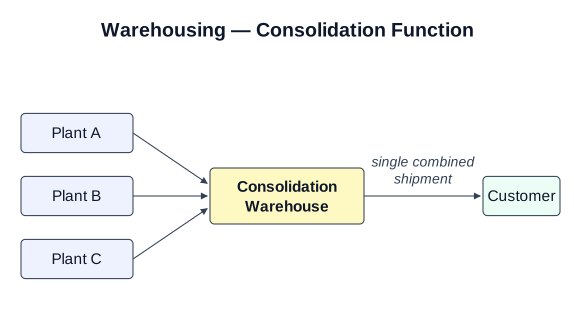
Drawn by us to help you understand the concept clearly, and verified to make sure it's accurate. For exams, practice from your NCERT textbook's own diagram.
What the Figure Shows
Our own schematic of the consolidation function of warehousing: goods arriving from several plants are combined in the warehouse and sent out as one eco …
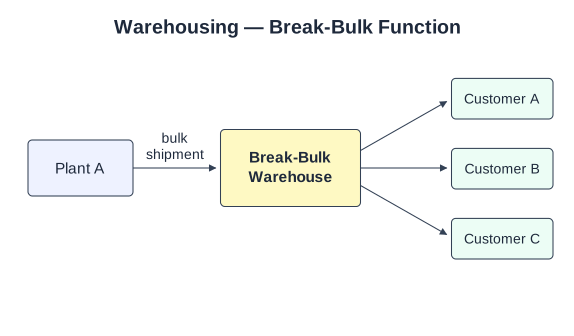
Drawn by us to help you understand the concept clearly, and verified to make sure it's accurate. For exams, practice from your NCERT textbook's own diagram.
What the Figure Shows
Our own schematic of the break-bulk function of warehousing: one large bulk shipment is received and split in the warehouse into smaller lots d …