Physical Education · Ch 5 — Physical Fitness, Wellness and Lifestyle
Components of Health-Related Fitness
Components of Health-Related Fitness
The health-related components relate directly to a person's health and everyday functioning, and they matter to every person, athlete or not. There are five of them.
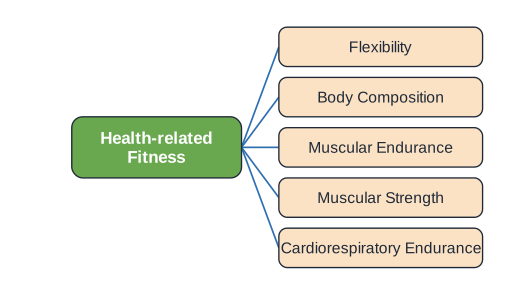
Drawn by us to help you understand the concept clearly, and verified to make sure it's accurate. For exams, practice from your NCERT textbook's own diagram.
A labelled cluster of the five health-related fitness components grouped around a central 'Health-related Fitness' label: Cardiorespiratory Endurance, Muscular Strength, Muscular Endurance, …
1. Body composition
The relative percentage of fat and lean body mass. Lean body mass is the fat-free mass - muscle, bone and other tissues except fat. A healthy person has a relatively low percentage of body fat. It is worth checking regularly, because excess body fat is linked with heart disease, diabetes and hypertension.
2. Muscular endurance
The ability of a muscle or muscle group to exert itself repeatedly, executing repeated contractions (or holding a contraction) over a period of time without undue fatigue. A fit person can repeat a movement for longer. It is measured using free weights (barbells, dumbbells), a gym mat (curl-ups, push-ups) and a stopwatch.
3. Cardiorespiratory endurance
The ability of the heart, blood vessels, blood and respiratory system to supply nutrients and oxygen to the muscles, and of the muscles to use that fuel, to allow continuous exercise. A person with good cardiorespiratory endurance can sustain activity for long without undue stress. These activities are aerobic - walking, jogging, swimming, cycling, cross-country running, skiing, water aerobics, climbing stairs and skipping.
4. Muscular strength
The maximum force that a specific muscle or muscle group can exert against a resistance in a single effort. A strong person can do work that involves exerting force - lifting, pushing a cupboard, lifting a gas cylinder, or controlling their own body weight.
5. Flexibility
The ability of a joint to move effectively through its full range of motion without pain. It depends on muscle length, joint structure and other factors. A lack of flexibility reduces daily performance and causes problems such as lower-back pain. Whole-body flexibility cannot be tested in one go, but the sit-and-reach test is widely used to assess the flexibility of the hamstrings, hips and lower back. …