Physical Education · Ch 6 — Test, Measurement & Evaluation
Importance of Test, Measurement and Evaluation in Sports
Importance of Test, Measurement and Evaluation in Sports
The importance of test, measurement and evaluation is best understood from three points of view - the athlete's, the coach/trainer's, and the training programme's. Each benefits in a different way, and together they show why objective assessment is indispensable in sport.
A. From the athlete's / participant's perspective
Drawn by us to help you understand the concept clearly, and verified to make sure it's accurate. For exams, practice from your NCERT textbook's own diagram.
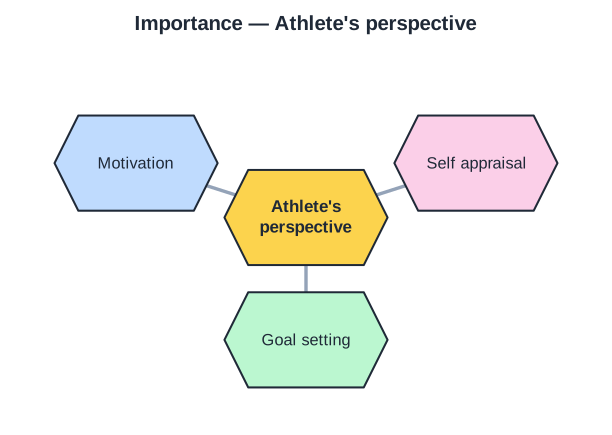
A hub-and-spoke diagram with 'Athlete's perspective' at the centre, connected to three outer nodes - Motivation (to continue the activity), Self-appraisal (of one's own performance) and Goal-set …
For the athlete, well-timed and appropriately frequent testing is a source of motivation, honest self-knowledge and clear targets:
- Motivation for continuity - an appropriate test, applied at the right time and frequency, is greatly motivating and encourages the athlete to keep up the activity. Seeing a concrete score, and watching it improve, gives visible proof of progress and builds commitment.
- Self-appraisal of performance - testing is a mode of honest self-assessment, letting athletes see exactly where they stand in each component rather than relying on a vague feeling.
- Goal-setting for performance enhancement - knowing the current baseline allows athletes to set realistic new goals and work purposefully towards improving them.
B. From the coach's / trainer's perspective
Drawn by us to help you understand the concept clearly, and verified to make sure it's accurate. For exams, practice from your NCERT textbook's own diagram.
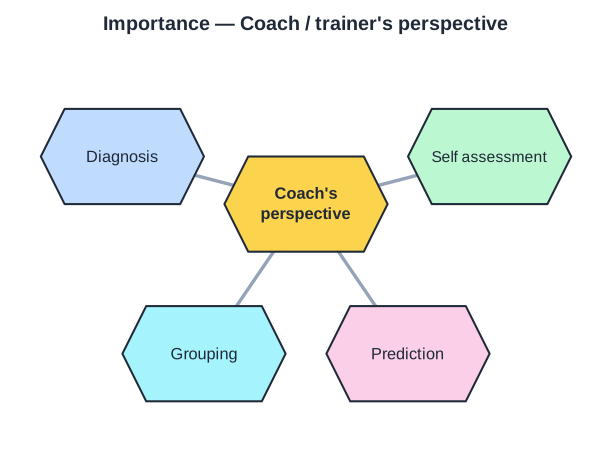
A hub-and-spoke diagram with 'Coach's perspective' at the centre, connected to four outer nodes - Diagnosis (of problems and teaching-learning errors), Grouping (of athletes by ability), Prediction (of performance) and Self …
For the coach, PE teacher or trainer, assessment supplies the authentic feedback on which good teaching and training depend; without a reliable test-measurement-evaluation system a coach lacks support for judging their own methods. Its main uses are:
- Diagnosis of problems and errors in the teaching-learning process - results reveal exactly which components or skills are weak, so the coach can target the real problem instead of guessing, and identify pedagogical issues to improve.
- Grouping / divisioning of athletes by ability or skill - scores let learners of similar ability be placed together, which makes teaching more efficient, keeps competition fair and reduces the risk of injury from mismatched pairings.
- Prediction of performance - because certain scores correlate with later success, testing helps the coach estimate an athlete's potential and plan for the long term.
- Self-assessment of teaching effectiveness - re-testing shows whether learners are actually improving, which is direct feedback on whether the coach's methods and training are working.
C. From the training-programme perspective
Drawn by us to help you understand the concept clearly, and verified to make sure it's accurate. For exams, practice from your NCERT textbook's own diagram.
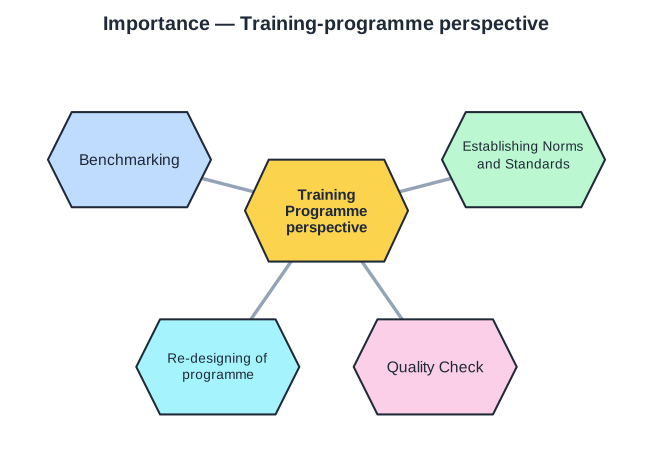
A hub-and-spoke diagram with 'Training Programme perspective' at the centre, connected to four outer nodes - Benchmarking of the programme, Establishing Norms and Standards, Quality Check/control, and Re-designing …
Training programmes are dynamic and need regular, scientifically-based updates; test, measurement and evaluation provide the evidence for changing them wisely:
- Benchmarking of the training programme - comparing it against desired objectives and outcomes, and against other existing training approaches.
- Establishing norms and standards - setting benchmarks for future objectives in skill, fitness and other abilities. …