Physical Education · Ch 10 — Training & Doping in Sports
Adaptation and Recovery
Adaptation and Recovery
Adaptation
In its literal sense, adaptation means to get adjusted. Just as a living organism adjusts to its environment, the human body can modify itself to a new state of performance efficiency in response to an external training load — so load and adaptation always go side by side. The adaptation to training is largely biochemical and applies to the conditional abilities (strength, speed-endurance). When the athlete meets training and competition demands, the body's homeostasis (internal balance) is disturbed; the body works to restore that balance, and when the balance is disturbed again and again over a period, it responds with structural and metabolic changes that let it withstand the load more efficiently. This improvement is adaptation.
Three conditions must be met for adaptation to a training load:
- the training load must match the loading capacity of the sportsperson;
- the recovery period must be in proportion to the load;
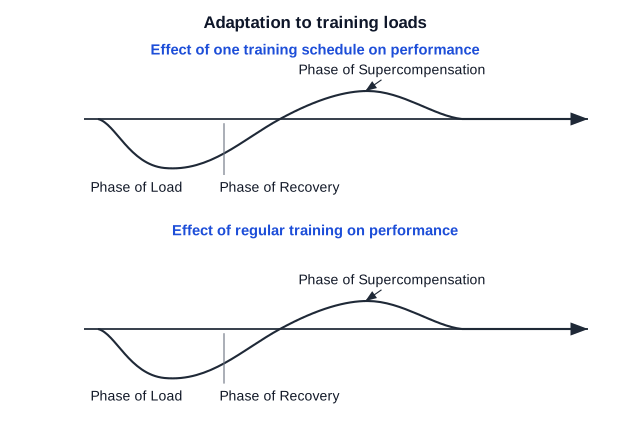
- the loading-and-recovery process must be repeated over a certain period (about 10 to 20 days).
Drawn by us to help you understand the concept clearly, and verified to make sure it's accurate. For exams, practice from your NCERT textbook's own diagram.
Two small performance-versus-time curves labelled 'Adaptation to training loads'. (a) 'Effect of one training schedule on performance': a Phase of Load drops performance, a Phase of Recovery returns it, and a Phase of Supercompensation lifts it above the starting level. (b) 'Effect of regular training on performance': the same load-recovery-supercompensation pattern repeated so that perf …
Drawn by us to help you understand the concept clearly, and verified to make sure it's accurate. For exams, practice from your NCERT textbook's own diagram.
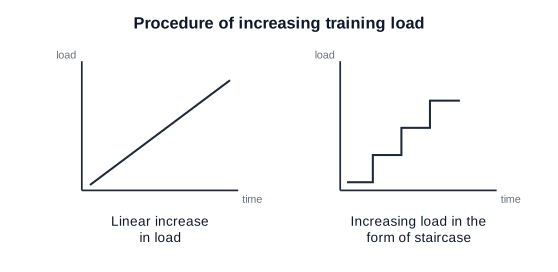
Two simple schematic graphs labelled 'Procedure of increasing training load', each with a horizontal time axis and a vertical load axis. The left graph, 'Linear increase in load', shows a single straight line rising steadily. The right graph, 'Increasing load in the form of staircase', shows a step/staircase lin …
Conditions of adaptation
To make each training unit effective, three further conditions are observed:
- (a) Adaptation is maximum when the load is given on an individual basis, keeping the specific character of the athlete in mind.
- (b) There must be a correct proportion between the intensity and volume of the load — intensity and volume have an inverse relationship.
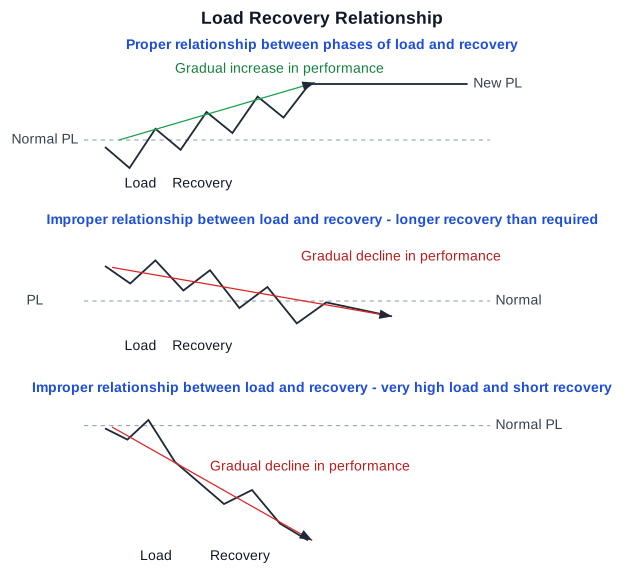
- (c) The adaptation process depends on the correct proportion between the phases of load and recovery.
Recovery
Both training and competition loads enhance performance, and over the long term the load is gradually increased to improve it. A beginner adapts to load quickly; as training age rises, higher loads are used and performance grows more slowly. Athletes cannot sustain very high loads unless proper means are used to speed up recovery. Recovery is the period and process during which the body responds to load — adequate recovery produces positive adaptation, while inadequate recovery produces maladaptation, poorer performance and greater injury/illness risk.
Drawn by us to help you understand the concept clearly, and verified to make sure it's accurate. For exams, practice from your NCERT textbook's own diagram.
Three schematic performance curves labelled 'Load Recovery Relationship'. (1) 'Proper relationship between phases of load and recovery': alternating load dips and recovery rises trend upward, so a New performance level (PL) sits above the Normal PL (gradual increase in performance). (2) 'Improper - longer recovery than required': the trend line slopes gently downward (gradual decline in performance). (3) 'Improper - very high load and short recover …
Recovery takes a considerable amount of time and passes through three stages:
- Stage I — fatigue and recovery occur together as the activity progresses, driven by the resynthesis of ATP, creatine phosphate and glycogen and the neutralisation of lactic acid; it depends on the efficiency of the body's systems and organs.
- Stage II — begins when activity stops and ends when homeostasis is restored, lasting from a few minutes to 2-3 hours; it can be hastened by active means such as deep-breathing exercises and drinks containing carbohydrates, vitamins, salts and minerals. …