Biology · Ch 11 — Photosynthesis in Higher Plants
Where does Photosynthesis take Place?
Where does Photosynthesis take Place?
The obvious answer to where photosynthesis happens is 'in the green leaf' or 'in the chloroplasts', based on what was learnt in Chapter 8. This is correct: photosynthesis takes place in the green leaves of plants, but it also occurs in other green parts of plants. The mesophyll cells of the leaves contain a very large number of chloroplasts. Usually the chloroplasts align themselves along the walls of the mesophyll cells so that they receive the optimum quantity of incident light.
Within the chloroplast there is a membranous system consisting of the grana, the stroma lamellae, and the fluid matrix (stroma). There is a clear division of labour within the chloroplast:
- The membrane system (grana and stroma lamellae) is responsible for trapping light energy and for the synthesis of ATP and NADPH.
- In the stroma, enzymatic reactions synthesise sugar, which in turn forms starch.
The two sets of reactions are named for how they relate to light:
- The membrane reactions, being directly driven by light, are called light reactions (photochemical reactions).
- The stromal reactions are not directly light-driven but depend on the products of the light reactions (ATP and NADPH). By convention they are called dark reactions (carbon reactions). …
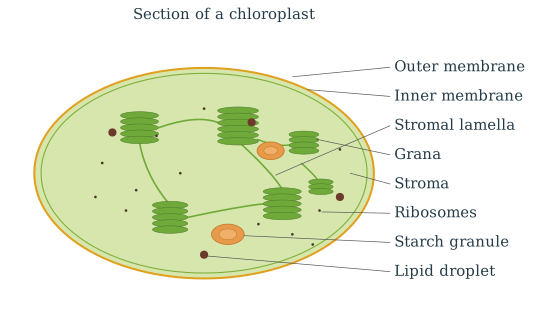
Drawn by us to help you understand the concept clearly, and verified to make sure it's accurate. For exams, practice from your NCERT textbook's own diagram.
This diagram shows the internal structure of a chloroplast as seen in an electron micrograph. The organelle is bounded by a double envelope, labelled the outer membrane and the inner membrane. Inside lies the fluid stroma, in which float ribosomes, a starch granule and a lipid droplet. The membrane system is organised into stacked disc-like grana, which are interconnected by stromal lamellae. This organisation reflects a division of labour: the grana and stroma lamellae trap light energy and make ATP and NADPH during the light reaction, whi …