Chemistry · Ch 6 — Equilibrium
Acids, Bases and Salts
Acids, Bases and Salts
Acids, Bases and Salts in Nature
Acids, bases and salts are everywhere around us. The hydrochloric acid in your stomach — about 1.2 to 1.5 litres secreted daily by the stomach lining — is essential for digestion. Vinegar owes its sharp taste to acetic acid. Lemons and oranges contain citric acid and ascorbic acid (vitamin C), while tamarind paste gets its sourness from tartaric acid. The word "acid" itself comes from the Latin acidus, meaning sour.
Acids turn blue litmus paper red. They react with certain metals to liberate dihydrogen gas. Bases, on the other hand, turn red litmus paper blue, taste bitter, and feel soapy to the touch. Washing soda is a common example of a base. When acids and bases are mixed in the right proportions, they react to form salts. Common salt (sodium chloride), barium sulphate, and sodium nitrate are familiar examples.
Sodium chloride forms when hydrochloric acid reacts with sodium hydroxide. In the solid state, it exists as a cluster of positively charged sodium ions () and negatively charged chloride ions (), held together by electrostatic interactions between oppositely charged species.
Drawn by us to help you understand the concept clearly, and verified to make sure it's accurate. For exams, practice from your NCERT textbook's own diagram.
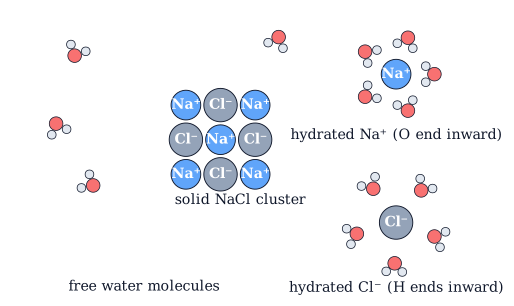
Fig. 6.10 is a molecular-level cartoon, not a graph. It shows a small cluster of the sodium chloride crystal lattice at the centre — alternating Na⁺ and Cl⁻ ions packed together. Surrounding this solid chunk are individual Na⁺ and Cl⁻ ions that have left the lattice and are now floating freely in water. Each free ion is surrounded by several water molecules, oriented in a specific way: the oxygen end (partially negative) of water points toward the Na⁺ ion, and the hydrogen ends (partially positive) point toward the Cl⁻ ion. The rest of the space is filled with unbound water molecules, drawn as simple V-shaped molecules.
The physical idea is that the dissolution of an ionic solid is not just a simple mixing. The polar water molecules pull ions off the crystal surface by surrounding each ion with the oppositely charged end of the water dipole. This process — called hydration — stabilises the separated ions in solution. Without hydration, the electrostatic attraction between Na⁺ and Cl⁻ would keep them locked in the crystal. The figure makes clear that the ions do not exist as bare charged spheres in water; they are always surrounded by a shell of oriented water molecules.
This figure directly supports the textbook's distinction between strong and weak electrolytes. Sodium chloride is a strong electrolyte because, as the figure shows, nearly every NaCl unit that dissolves breaks completely into hydrated Na⁺ and Cl⁻ ions. There is no equilibrium between NaCl molecules and ions — the dissociation is essentially 100%. In contrast, a weak electrolyte like acetic acid would be shown with most molecules remaining intact and only a few ions present.
The key formula that the textbook develops from this idea is the equilibrium constant for ionic dissociation of a weak electrolyte. For a general weak acid HA:
where is the acid dissociation constant, is the concentration of hydronium ions, is the concentration of the conjugate base, and is the concentration of unionised acid. For a weak base B:
where is the base dissociation constant, is the concentration of the conjugate acid, is the hydroxide ion concentration, and is the concentration of unionised base. …
The electrostatic force between two charges is inversely proportional to the dielectric constant of the medium. Water has a very high dielectric constant of about 80. When sodium chloride dissolves in water, the electrostatic attractions between ions are reduced by a factor of 80. This allows the ions to move freely in solution, and they become well-separated due to hydration by water molecules.
Ionization and Dissociation
Consider the behaviour of hydrochloric acid and acetic acid in water. Both are polar covalent molecules, yet they behave very differently. Hydrochloric acid is completely ionized into its constituent ions ( and ), while acetic acid is only partially ionized — typically less than 5% of its molecules split into ions.
The extent to which ionization occurs depends on two factors:
- The strength of the bond within the molecule
- The extent of solvation (hydration) of the ions produced
The terms "dissociation" and "ionization" have historically carried different meanings. Dissociation refers to the separation of ions that already exist as such in the solid state of the solute — as in sodium chloride, where and ions are already present in the crystal lattice. Ionization, on the other hand, refers to a process in which a neutral molecule splits into charged ions only when it goes into solution. In this chapter, we shall not distinguish between the two and will use the terms interchangeably.
Faraday's Contributions
Michael Faraday's own experiments on the electrical conductivity of solutions are what first established the electrolyte classification this chapter builds on.
The textbook's biographical box on Michael Faraday sits alongside the discussion of strong and weak electrolytes because it was Faraday's own experiments — testing which aqueous solutions conduct electricity, and how strongly — that first established the distinction this chapter relies on.
Faraday (1791–1867) was born near London into a family of very limited means. He began as an apprentice bookbinder, and it was through reading the books he was binding that he developed an interest in science. He became a laboratory assistant to Humphry Davy, succeeded him as Director of the Royal Institution laboratories in 1825, and became its first Fullerian Professor of Chemistry in 1833. …
Faraday's laws of electrolysis (1834) established the quantitative relationship between the amount of substance liberated at an electrode and the quantity of electricity passed through the electrolyte. These laws are fundamental to understanding the behaviour of electrolytes — substances that conduct electricity when dissolved in water due to the presence of ions.
Key Concepts Recap
| Concept | Description |
|---|---|
| Acids | Turn blue litmus red; taste sour; liberate with some metals |
| Bases | Turn red litmus blue; taste bitter; feel soapy |