Chemistry · Ch 9 — Hydrocarbons
Nomenclature and Isomerism
Nomenclature and Isomerism
Nomenclature of Aromatic Hydrocarbons
The naming system for aromatic hydrocarbons follows the same IUPAC rules you studied in Unit 8. For benzene derivatives, the parent name is "benzene," and substituents are named as prefixes. When there are two or more substituents, their positions are indicated by numbers, and the substituents are listed alphabetically.
For example, a methyl group attached to benzene gives methylbenzene, commonly called toluene. Two methyl groups give dimethylbenzene, with three possible arrangements depending on which carbon atoms carry the methyl groups.
The Equivalence of Benzene Hydrogens
All six hydrogen atoms in benzene are chemically equivalent. This means that replacing any one hydrogen with another atom or group produces exactly one monosubstituted product — there is no possibility of positional isomers for a single substituent.
Because all six hydrogens in benzene are identical, benzene forms one and only one type of monosubstituted product. No matter which hydrogen you replace, you get the same compound.
Position Isomerism in Disubstituted Benzenes
When two hydrogen atoms in benzene are replaced by two monovalent atoms or groups (which may be the same or different), three distinct position isomers become possible. These arise because the two substituents can occupy different relative positions on the ring.
The three isomers are named using both numerical locants and the traditional ortho, meta, para system:
| Numerical positions | Traditional name | Abbreviation | Meaning |
|---|---|---|---|
| 1,2 (or 1,6) | ortho | o- | "straight" — adjacent carbons |
| 1,3 (or 1,5) | meta | m- | "beyond" — one carbon between them |
| 1,4 | para | p- | "opposite" — two carbons between them |
The numbering 1,2 and 1,6 refer to the same relative arrangement because the ring is symmetric. Similarly, 1,3 and 1,5 are equivalent. The standard convention is to use the smaller numbers: 1,2 for ortho, 1,3 for meta, and 1,4 for para.
Examples of Disubstituted Benzene Derivatives
The textbook illustrates these isomers using dimethylbenzene (two methyl groups on benzene), commonly known as xylene.
Methylbenzene (Toluene) — a monosubstituted compound:
1,2-Dimethylbenzene (o-Xylene) — the two methyl groups are on adjacent carbons:
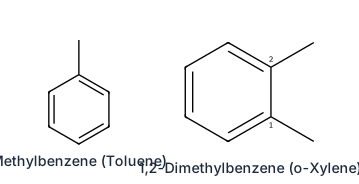
Drawn by us to help you understand the concept clearly, and verified to make sure it's accurate. For exams, practice from your NCERT textbook's own diagram.
The monosubstituted and ortho-disubstituted examples from the textbook's own nomenclature panel: methylbenzene (toluene), and 1,2-dimethylbenzene (o-xylene), whose ring is numbered 1,2 to show the tw …
1,3-Dimethylbenzene (m-Xylene) — one unsubstituted carbon separates the methyl groups:
1,4-Dimethylbenzene (p-Xylene) — the methyl groups are opposite each other:
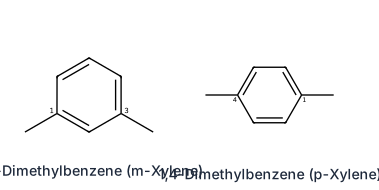
Drawn by us to help you understand the concept clearly, and verified to make sure it's accurate. For exams, practice from your NCERT textbook's own diagram.
The remaining two xylene isomers from the same panel: 1,3-dimethylbenzene (m-xylene), numbered 1,3 with one ring carbon between the methyl groups, and 1,4-dimethylbenzene (p-xylene), numbered 1,4 with the methy …
A common mistake is to think that 1,5-dimethylbenzene is a different compound from 1,3-dimethylbenzene. They are the same — numbering always starts from the substituent that gives the smallest locants, so 1,3 is preferred over 1,5.
The textbook pauses its nomenclature discussion here for a biographical box on August Kekulé, because the structures on this very page trace back to him. Kekulé was born in 1829 at Darmstadt in Germany, became a Professor in 1856 and a Fellow of the Royal Society in 1875. His two landmark contributions to structural organic chemistry frame this whole section: in 1858 he proposed that carbon atoms can join to one another to form chains, and in 1865 he answered the challenging problem of benzene's structure by suggesting that such chains can close on themselves to form rings. The dynamic structural formula he gave benzene — the oscillating double-bond picture discussed in §9.5.2 — is the basis for its modern electronic structure. …
Key Principle: Why Only Three Isomers?
The benzene ring has six equivalent positions. When you place the first substituent at position 1, the second substituent can go at position 2, 3, or 4. Positions 5 and 6 are equivalent to 3 and 2 respectively (due to symmetry), so no new isomers arise. This gives exactly three distinct disubstituted isomers for any pair of identical substituents. …