Chemistry · Ch 7 — Redox Reactions
Competitive Electron Transfer Reactions
Competitive Electron Transfer Reactions
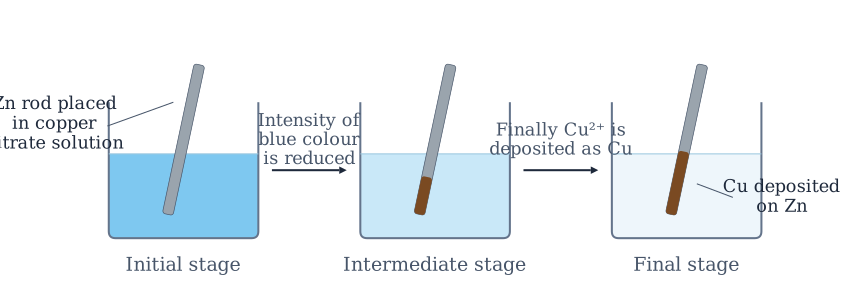
When a strip of metallic zinc is placed in an aqueous solution of copper nitrate, a striking change occurs within about an hour. The zinc strip becomes coated with a reddish deposit of metallic copper, and the characteristic blue colour of the copper nitrate solution fades completely. The disappearance of the blue colour signals that ions are being removed from the solution. To confirm that ions have formed in their place, hydrogen sulphide gas is passed through the now-colourless solution. When the solution is made alkaline with ammonia, a white precipitate of zinc sulphide () appears — a clear indication that zinc ions are present.
Drawn by us to help you understand the concept clearly, and verified to make sure it's accurate. For exams, practice from your NCERT textbook's own diagram.
The figure shows a simple beaker experiment. A strip of zinc metal is partially immersed in a blue solution of copper(II) nitrate, . Over time, a reddish-brown coating of metallic copper appears on the surface of the zinc strip, and the blue colour of the solution fades. The blue colour comes from hydrated ions; as these ions disappear, the solution becomes colourless (or very pale, due to the ions that replace them).
This is a classic displacement reaction. The zinc, being more reactive than copper, donates electrons to the copper ions. Each zinc atom loses two electrons to become a ion, which goes into solution. Each ion gains those two electrons and becomes neutral copper metal, which plates out onto the zinc strip.
The physical idea is that the reaction is an electron transfer — it is a redox reaction in the most literal sense. The zinc is oxidised (it loses electrons), and the copper(II) ions are reduced (they gain electrons). The figure makes this abstract idea visible: you can see the copper appearing and the blue colour vanishing.
The two half-reactions that describe this change are:
Adding these two half-reactions gives the overall ionic equation:
The nitrate ions, , are spectator ions — they do not change during the reaction. The full molecular equation (including the spectator ions) is:
…
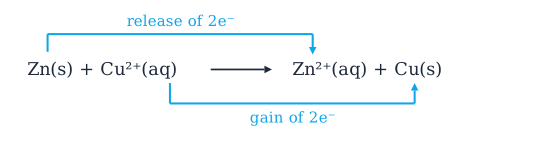
The reaction that takes place is:
In this process, zinc atoms lose two electrons to become ions — zinc is oxidised. Those electrons do not vanish; they are accepted by copper ions, which are reduced to metallic copper. The reaction can be split into two half-reactions:
Drawn by us to help you understand the concept clearly, and verified to make sure it's accurate. For exams, practice from your NCERT textbook's own diagram.
Reaction 7.15 rewritten with its electron flow drawn in: zinc releases 2e⁻ as it becomes Zn²⁺ (upper arrow) and the copper(II) ion gains 2e⁻ to deposit as copper metal (lower arrow). One species’ …
The key question is: how far does this reaction go? Does it reach an equilibrium where both reactants and products coexist in significant amounts, or does it run almost to completion?
The Equilibrium Favours Products
To investigate the equilibrium position of reaction (7.15), we perform the reverse experiment: place a strip of metallic copper in a solution of zinc sulphate. No visible reaction occurs. The copper strip remains unchanged, and the solution stays colourless. To be absolutely certain that no ions have formed, hydrogen sulphide gas is passed through the solution. Cupric sulphide () is so insoluble that even trace amounts of produce a visible black precipitate. Yet no black colour appears. The amount of formed, if any, is below the detection limit of this extremely sensitive test.
The equilibrium for the reaction lies far to the right — the products are overwhelmingly favoured over the reactants.
This tells us that zinc has a much stronger tendency to release electrons than copper does. When given the chance, zinc will readily donate electrons to copper ions, but copper will not donate electrons to zinc ions.
Extending the Competition: Copper and Silver
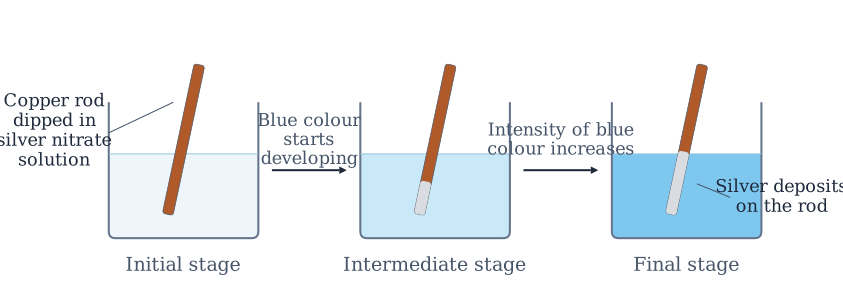
Now consider a strip of metallic copper placed in an aqueous solution of silver nitrate. The set-up is shown in the figure below.
Drawn by us to help you understand the concept clearly, and verified to make sure it's accurate. For exams, practice from your NCERT textbook's own diagram.
The figure shows a copper rod immersed in a colourless solution of silver nitrate (). Over time, two visible changes occur. First, shiny, silvery crystals of metallic silver begin to deposit on the surface of the copper. Second, the solution itself turns a pale blue colour. The blue colour is the signature of aqueous copper(II) ions, .
What the figure captures is a spontaneous displacement reaction. Copper metal, being more reactive than silver, donates electrons to the silver ions in solution. Each copper atom loses two electrons to become a ion, which enters the solution and gives it the blue tint. Meanwhile, each silver ion in solution gains one electron to become a neutral silver atom, which plates out as the visible metallic crystals.
The overall chemical change is:
But the real teaching point of the figure is that this single reaction can be split into two half-reactions that reveal the electron transfer.
The copper metal acts as the reducing agent — it loses electrons and gets oxidised. The silver ions act as the oxidising agent — they gain electrons and get reduced. The figure makes this electron transfer visible: the appearance of silver crystals is direct evidence of reduction, and the blue colour of the solution is direct evidence of oxidation.
A common mistake is to think the blue colour comes from silver ions. It does not — silver ions in solution are colourless. The blue colour is exclusively due to ions. …
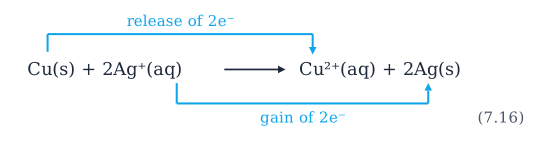
Within a short time, the solution develops a blue colour — the unmistakable sign of ions. The reaction is:
Drawn by us to help you understand the concept clearly, and verified to make sure it's accurate. For exams, practice from your NCERT textbook's own diagram.
Reaction 7.16 with the electron transfer drawn in: copper releases 2e⁻ to become Cu²⁺ — the blue colour that develops in the solution — while two Ag⁺ ions together gain 2e⁻ and depo …
Here, copper is oxidised to , and silver ions are reduced to metallic silver. Once again, the equilibrium greatly favours the products — and are formed in abundance, and the reverse reaction is negligible.
Notice the pattern: zinc displaces copper from its salt solution, and copper displaces silver from its salt solution. Each metal is able to reduce the ion of the metal that comes after it in this sequence.
A Contrast: Cobalt and Nickel
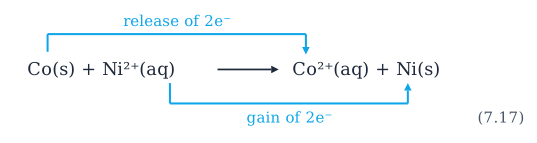
Not all such competitions are one-sided. Consider metallic cobalt placed in a nickel sulphate solution. The reaction that occurs is:
Drawn by us to help you understand the concept clearly, and verified to make sure it's accurate. For exams, practice from your NCERT textbook's own diagram.
Reaction 7.17 with its electron flow drawn in: cobalt releases 2e⁻ to become Co²⁺ while the nickel(II) ion gains 2e⁻ and deposits as nickel. Unlike 7.15 and 7.16, this competition is close — at equilibrium both …
When this system reaches equilibrium, chemical tests reveal that both and are present at moderate concentrations. Neither the reactants nor the products are overwhelmingly favoured. The equilibrium lies somewhere in the middle.
Do not assume that every metal displacement reaction goes to completion. The position of equilibrium depends on the relative tendencies of the two metals to release electrons. Some competitions are close, and both oxidation states coexist.
The Analogy with Acids
This competition among metals for the release of electrons is strikingly similar to the competition among acids for the release of protons. Just as some acids (like HCl) donate protons readily while others (like acetic acid) donate them weakly, some metals (like zinc) release electrons eagerly while others (like silver) hold onto them tightly.
This analogy suggests a powerful idea: we can arrange metals and their ions in a table based on their tendency to release electrons — a metal activity series or electrochemical series. From the comparisons we have already made:
- Zinc releases electrons to copper ions → zinc is a stronger electron donor than copper.
- Copper releases electrons to silver ions → copper is a stronger electron donor than silver.
Therefore, the electron-releasing tendency of these three metals is:
The metal activity series ranks metals in order of decreasing tendency to lose electrons (i.e., decreasing reducing power). A metal higher in the series can displace the ion of a metal lower in the series from its salt solution.