Mathematics · Ch 10 — Conic Sections
Circle
Circle
10.3 Circle
Definition and the Standard Equation
A circle is the set of all points in a plane that are at a fixed distance from a fixed point in that plane. The fixed point is called the centre of the circle, and the fixed distance is called the radius.
To derive the equation, let be the centre and the radius. Take any point on the circle. By definition, the distance equals . Using the distance formula:
Squaring both sides gives the standard equation of a circle:
This is the equation of a circle with centre at and radius .
When the centre is at the origin , the equation simplifies to .
General Equation of a Circle
Any equation of the form can represent a circle. To see this, complete the square:
Comparing with :
- Centre:
- Radius: …
A circle is the set of all points in a plane that are at a fixed distance from a fixed point in that same plane. The fixed point is called the centre, and the fixed distance is called the radius.
That is the complete definition. It has two essential conditions: (i) every point on the circle is exactly at that distance from the centre, and (ii) every point at that distance from the centre lies on the circle. The definition does not require the centre to be at the origin — that is just a special case.
The word "equidistant" means "the same distance." So a circle is the set of all points that are equally far from one central point.
Intuition: Imagine tying a string of fixed length to a pencil. Hold the other end of the string fixed on a sheet of paper (that's the centre). Keeping the string taut, move the pencil all the way around. The curve you trace is the circle — every point on it is exactly the string's length away from the fixed point.
Tiny concrete example: …
Drawn by us to help you understand the concept clearly, and verified to make sure it's accurate. For exams, practice from your NCERT textbook's own diagram.
What Fig. 10.11 Shows
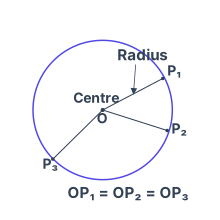
The figure is a simple, clean diagram of a circle. At its centre is a point labelled O. Three distinct points on the circumference are marked P₁, P₂, and P₃. From O to each of these three points, a straight line segment is drawn. Each segment is labelled with the word "Radius", and the diagram explicitly notes that all three lengths are equal: .
There are no axes, no grid, and no coordinate system in this figure. It is purely geometric — a visual definition, not a graph. The only labels are the centre O, the three points on the circle, and the word "Radius" pointing to one of the segments.
The Physical Idea It Teaches
This figure exists to make the definition of a circle concrete before any algebra enters the picture. A circle is not a shape you draw with a compass; it is a condition — the set of all points that lie at a fixed distance from a fixed point. The diagram shows exactly that condition in action.
The fixed point is O, the centre. The fixed distance is the length of any one of those three segments, the radius. The three points P₁, P₂, and P₃ are just three examples from the infinite set of points that satisfy the condition. The fact that all three radii are equal is not a coincidence of the drawing — it is the defining property that makes the curve a circle. If you picked any other point on the curve, its distance to O would be the same.
This is why a circle is defined by two parameters: the location of its centre and the length of its radius. Everything else — size, position, equation — follows from these two pieces of information.
The Key Formula the Textbook Develops from This Figure
The figure leads directly to the general equation of a circle. The reasoning is straightforward:
Let the centre be at coordinates and let the radius be . Take any point on the circle. By the definition shown in Fig. 10.11, the distance must equal . Using the distance formula:
Squaring both sides gives the standard equation:
Here:
- is the centre of the circle
- is the radius
- is any point on the circle
The simplest special case occurs when the centre is at the origin . Then the equation reduces to:
This is the form used in Example 1 and in Exercise 10.1, question 15. …
Drawn by us to help you understand the concept clearly, and verified to make sure it's accurate. For exams, practice from your NCERT textbook's own diagram.
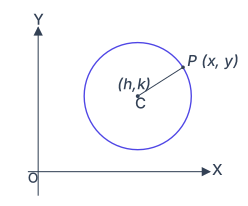
Fig. 10.12 is a simple coordinate-geometry diagram that shows how the definition of a circle — all points at a fixed distance from a centre — translates into an algebraic equation.
The figure shows the standard - axes with the origin labelled . A circle is drawn with its centre at a point , which is not at the origin. A radius is drawn from to a point on the circumference. The axes, the centre, and the point are all labelled. The diagram makes clear that and are the - and -coordinates of the centre, and that and are the coordinates of a general point on the circle.
The physical idea is straightforward: the distance from to is constant and equal to the radius . The figure turns this geometric fact into an algebraic condition by applying the distance formula between two points in the plane.
Here, is the centre of the circle, is its radius, and is any point on the circle. The equation says: the square of the distance from to equals . Every point that satisfies this equation lies on the circle; every point on the circle satisfies the equation.
The figure is the bridge between the verbal definition of a circle and the standard equation you will use in problems. When the centre is at the origin, , and the equation simplifies to — the special case shown in the preceding Fig. 10.11. …