Q.Let . Define a relation from to by .
The relation pairs each element in with , so only pairs where both numbers are in are included. The arrow diagram shows arrows from , , , , ; domain = , codomain = , range = .
Why an arrow diagram? The core idea
A relation from set to set is just a collection of ordered pairs . The rule here is . That means: take any from , add 1, and if the result is also in , then that pair belongs to . If the result falls outside , we simply skip it — the relation only contains pairs that actually exist.
An arrow diagram is the most visual way to show this: draw two copies of (left side for inputs, right side for outputs), and draw an arrow from each to its corresponding . It makes the domain, codomain, and range instantly clear.
Step-by-step solution
1. List all possible pairs from the rule
Take each and compute :
- → is in
- →
- →
- →
- →
- → , so this pair is not in
So .
A common mistake is to include because the rule says . But a relation from to requires both coordinates to belong to . Since , is not part of .
2. Draw the arrow diagram
Place the elements of in two vertical (or horizontal) lists. Draw an arrow from each on the left to its on the right:
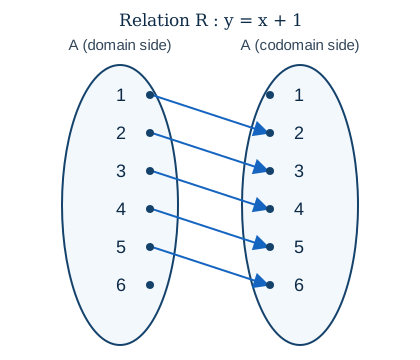
Notice that on the left has no outgoing arrow, and on the right has no incoming arrow. This is perfectly fine — not every element of the domain needs to be used, and not every element of the codomain needs to be hit.
3. Identify domain, codomain, and range
-
Domain: the set of all first coordinates (inputs that actually appear in ).
From the pairs: .
(Note: is in but never appears as a first coordinate in , so it is not in the domain.)
-
Codomain: the set itself — it is given as the target set in the definition “relation from to ”. So codomain = .
-
Range: the set of all second coordinates (outputs that actually appear in ).
From the pairs: .
(Note: is in the codomain but never appears as a second coordinate, so it is not in the range.)
Domain and range are actual sets of elements that occur in the relation. Codomain is the promised set of possible outputs — it can be larger than the range. Here, codomain has 6 elements, range has 5.
The arrow diagram shows arrows from , , , , ; domain = , codomain = , range = .
Unlock everything free for 14 days
- Full step-by-step solutions
- Concept-first explanations
- Methods, shortcuts & mistakes
- PYQ mapping + timed mock tests
Full access for 14 days. No credit card required.