Physics · Ch 13 — Oscillations
Simple Harmonic Motion and Uniform Circular Motion
Simple Harmonic Motion and Uniform Circular Motion
The Connection Between Circular Motion and SHM
Simple harmonic motion and uniform circular motion might seem like completely different phenomena — one is a back-and-forth oscillation along a straight line, the other is steady rotation around a circle. Yet they share a deep geometric link. Understanding this connection gives you a powerful visual way to think about SHM, and it lets you derive the equations of SHM without solving a single differential equation.
Imagine a particle moving with constant angular speed around a circle of radius . Now shine a light from the side, so that the particle casts a shadow on a screen placed behind the circle. As the particle goes around, the shadow moves back and forth along a straight line. That shadow's motion is simple harmonic.
This is the core idea of the section: the projection of uniform circular motion onto a diameter of the circle is simple harmonic motion.
Setting Up the Geometry
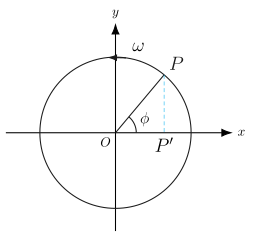
Consider a particle moving on a circle of radius with constant angular speed . At time , let be at the positive -axis (angle zero). After time , the radius vector makes an angle with the -axis.
Now drop a perpendicular from onto the -axis. The foot of this perpendicular is point . As moves around the circle, slides back and forth along the -axis. The position of at any time is simply the -coordinate of :
This is exactly the equation of simple harmonic motion with amplitude and angular frequency . The particle is called the reference particle, the circle is the reference circle, and is the projection of onto the diameter.
The choice of diameter is arbitrary. If you project onto the -axis instead, you get , which is just a phase-shifted version of the same SHM. The physics is unchanged.
Velocity in SHM from Circular Motion
The reference particle moves with uniform circular motion, so its speed is constant: , directed tangentially to the circle. At any instant, this velocity vector makes an angle with the vertical (or equivalently, an angle with the horizontal).
The -component of 's velocity is the velocity of the projection . From the geometry:
The negative sign appears because when is in the upper half of the circle (), the projection is moving leftward (negative -direction). This matches the SHM velocity formula .
A quick way to remember the sign: when the particle is at the extreme right (), velocity is zero. As it starts moving left, velocity is negative — hence the minus sign.
Acceleration in SHM from Circular Motion
The reference particle has centripetal acceleration , directed radially inward toward the centre of the circle. This acceleration vector always points along the radius , making an angle with the -axis.
The -component of 's acceleration gives the acceleration of the projection :
But , so:
This is the hallmark of SHM: acceleration is proportional to displacement from the mean position and directed opposite to it. The negative sign confirms that acceleration always points toward the equilibrium position ().
The Four Key Properties — Derived from the Circular Motion Picture
The textbook lists four properties that follow directly from this geometric interpretation. Each one is proved by considering the motion of the reference particle and its projection.
Property 1: The projection of uniform circular motion on any diameter is SHM
We have already shown this. For a particle moving with angular speed on a circle of radius , the -coordinate of its projection is , where is the initial phase. This satisfies the SHM equation .
›Proof
Formal proof
Let the reference particle have position vector with . The projection onto the -axis is . Differentiating twice:
Since , the motion of the projection is SHM.
Property 2: The amplitude of SHM equals the radius of the reference circle
The projection oscillates between and . These extremes occur when the reference particle is at the leftmost and rightmost points of the circle, respectively. The maximum displacement from the mean position is therefore , which is exactly the radius of the reference circle.
Property 3: The time period of SHM equals the time period of the reference particle's circular motion
The reference particle takes time to complete one full revolution. In that same time, the projection goes from one extreme to the other and back — one complete oscillation. Hence:
This is the same time period we derived from the SHM differential equation.
Property 4: The phase of SHM equals the angular displacement of the reference particle
At any instant , the reference particle's angular position is . The projection's position is . The angle is precisely the phase of the SHM. When , the projection is at the positive extreme; when , it passes through the mean position moving left; when , it is at the negative extreme; and so on.
A common confusion: students often think the phase is alone. Remember that the initial phase is determined by where the reference particle starts at . If it starts on the positive -axis, ; if it starts at the top of the circle, , and so on.
A Useful Table: Correspondence Between Circular Motion and SHM
| Quantity in circular motion | Quantity in SHM (projection) |
|---|---|
| Radius | Amplitude |
| Angular speed | Angular frequency |
| Time period | Time period |
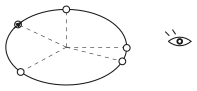
Drawn by us to help you understand the concept clearly, and verified to make sure it's accurate. For exams, practice from your NCERT textbook's own diagram.
The figure shows a ball moving in a circle, but the circle is drawn as an ellipse — that is the key visual trick. The circle is being viewed edge-on, meaning you are looking at it from the side, so the circular path appears squashed into an ellipse. The ball is shown at several positions along this elliptical path, and dashed lines (radii) connect each position to the centre of the ellipse. An eye symbol is drawn off to one side, indicating the direction from which the circle is being viewed.
What the figure teaches is this: when you look at uniform circular motion from the side, the back-and-forth motion you see along the line of sight is exactly simple harmonic motion. The ball is actually moving at constant speed around a full circle, but because you are viewing it edge-on, you only see its projection onto a line — the diameter of the circle that lies perpendicular to your line of sight. That projected motion is SHM.
The dashed radii are crucial: they show that at any instant, the ball's position on the circle corresponds to an angle measured from some reference direction (usually the positive x-axis). The projection of that radius onto the viewing line gives the displacement of the SHM. If the circle has radius (the amplitude of the SHM), and the ball moves with constant angular speed , then at time the angle is , where is the initial phase. The projection onto the viewing line (say the x-axis) is
This is the standard equation for SHM. The figure makes the connection concrete: the uniform circular motion of the ball is the "generator" of the SHM, and the dashed radii are the vectors whose horizontal (or vertical) component gives the instantaneous displacement.
where is the amplitude (radius of the circle), is the angular frequency (constant angular speed of the circular motion), is time, and is the initial phase angle.
The textbook uses this figure to derive the velocity and acceleration of SHM from the circular motion. The ball's velocity vector in circular motion has magnitude and is tangent to the circle. Its projection onto the viewing line gives the SHM velocity:
…
Drawn by us to help you understand the concept clearly, and verified to make sure it's accurate. For exams, practice from your NCERT textbook's own diagram.
The figure is built around a simple but powerful idea: the projection of uniform circular motion onto a diameter gives simple harmonic motion. This is the "reference circle" — a visual bridge between circular motion and oscillations.
At the centre of the diagram is a circle of radius , drawn on an - coordinate system. The centre is labelled O. A particle P moves on the circumference of this circle. Its position is specified by the angle that the radius OP makes with the positive -axis. An arrow curved anticlockwise around the circle, labelled , tells you that P moves with constant angular speed — that is, it executes uniform circular motion.
Now drop a perpendicular from P down to the -axis. The foot of this perpendicular is labelled P′. As P goes around the circle, P′ slides back and forth along the -axis. That back-and-forth motion is simple harmonic.
The physical idea is this: the -coordinate of P (which is the same as the position of P′) varies sinusoidally with time. If at the particle P is at an angle (the initial phase), then at a later time its angular displacement is . The -coordinate of P is therefore
This is the displacement of the projection P′ — and it is exactly the equation of simple harmonic motion. The amplitude of the SHM is the radius of the circle; the angular frequency of the SHM is the constant angular speed of P; and the phase constant is the initial angle from which P starts.
where is the amplitude, the angular frequency, and the initial phase.
The figure thus teaches that every SHM can be thought of as the shadow of a uniform circular motion. This is not just a geometric curiosity — it lets you derive velocity and acceleration of SHM directly from the circular motion. The velocity of P is tangential, of magnitude . Its -component gives the velocity of P′:
Similarly, the centripetal acceleration of P, of magnitude , has an -component that gives the acceleration of the SHM:
The last relation — — is the hallmark of simple harmonic motion. The reference circle makes it visually obvious why acceleration is always opposite to displacement and proportional to it. …