Business Studies · Ch 11 — Consumer Protection
Redressal Agencies Under the Consumer Protection Act
Redressal Agencies Under the Consumer Protection Act
The Consumer Protection Act 2019 sets up a three-tier machinery to handle consumer grievances. This structure ensures that a consumer can seek justice at a level appropriate to the value of their claim, and that there is a clear path for appeal if they are dissatisfied with the outcome. The three levels are the District Commission, the State Commission, and the National Commission.
The Three-Tier Redressal Machinery
The jurisdiction of each commission is determined by the monetary value of the goods or services paid as consideration (the price paid).
1. District Commission
- Jurisdiction: Handles complaints where the value of goods or services paid as consideration does not exceed Rs 50 lakh.
- Process: If, at the first hearing or any later stage, the commission believes a settlement is possible, it may direct the parties to give their consent for mediation within five days. If both parties agree in writing, the matter is referred to mediation. If mediation fails, the commission proceeds with the complaint.
- Handling Defects: If a complaint alleges a defect in goods that requires analysis or testing, the commission will obtain a sample of the goods, seal it, and send it to the appropriate authority for analysis. For disputes involving services, the commission settles the matter based on evidence provided by the complainant and can demand any required information, documents, or records from the service provider.
- Appeals: Any party not satisfied with the order of the District Commission can appeal to the State Commission within 45 days from the date of the order. The appeal can be on grounds of fact or law.
2. State Commission
- Establishment: Established by the respective state government and ordinarily functions at the state capital.
- Jurisdiction: Handles complaints where the value of goods or services paid as consideration exceeds Rs 50 lakh but does not exceed Rs 2 crore.
- Appeals: Any party not satisfied with the order of the State Commission can appeal to the National Commission within 30 days of the order.
3. National Commission
- Jurisdiction: Has territorial jurisdiction over the whole country. It handles complaints where the value of goods or services paid as consideration exceeds Rs 2 crore.
- Appeals: Any party not satisfied with the order of the National Commission can appeal to the Supreme Court of India within 30 days of the order.
Finality of Orders
Every order of a District Commission, State Commission, or National Commission is deemed final if no appeal is made by any of the parties involved in the dispute within the specified time limit.
Relief Available to Consumers
When a District, State, or National Commission is satisfied that there is a defect in goods, a deficiency in service, an unfair trade practice, or a claim for compensation under product liability, it can issue an order for one or more of the following reliefs:
- (i) To remove the defect in goods or deficiency in service.
- (ii) To replace the defective product with a new one, free from any defect.
- (iii) To refund the price paid for the product, or the charges paid for the service.
- (iv) To pay a reasonable amount of compensation for any loss or injury suffered by the consumer due to the negligence of the opposite party.
- (v) To pay punitive damages in appropriate circumstances.
- (vi) To discontinue the unfair or restrictive trade practice and not to repeat it in the future.
- (vii) Not to offer hazardous goods for sale.
- (viii) To withdraw the hazardous goods from sale.
- (ix) To cease manufacture of hazardous goods and to desist from offering hazardous services.
- (x) To compensate for any loss or injury suffered by a consumer under a product liability action and to withdraw hazardous products from being offered for sale.
Role of Consumer Organisations and NGOs
Several consumer organisations and non-governmental organisations (NGOs) in India work for the protection and promotion of consumers' interests. NGOs are non-profit organisations with their own constitution, free from government interference. They perform the following key functions:
- (i) Educating the general public about consumer rights by organising training programmes, seminars, and workshops. …
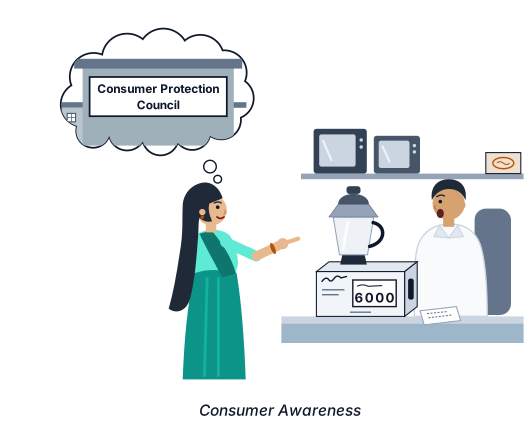
Drawn by us to help you understand the concept clearly, and verified to make sure it's accurate. For exams, practice from your NCERT textbook's own diagram.
Our own simplified rendering of the real page's illustration: a woman points at a defective appliance on a shop counter while speaking to the shopkeeper, with a thought bubble above her showing a building labelled "Consumer Protection Council". …