Computer Science · Ch 10 — Computer Networks
Modem
Modem
A modem is the device that makes internet access over telephone lines possible. The name itself tells you what it does: MOdulator DEModulator. It sits between a computer (which works with digital data — 0s and 1s) and a transmission medium like a telephone line (which carries analog signals — continuous waves).
Computers store and process data as digital bits. But when you send that data across a wire or through the air, the medium itself carries an analog signal. So the data has to be converted from one form to the other at both ends. That is the modem's entire job.
At the sender's end, the modem acts as a modulator: it takes the computer's digital data and converts it into an analog signal suitable for the transmission medium. At the receiver's end, the modem acts as a demodulator: it takes the incoming analog signal and converts it back into digital data that the destination computer can understand.
A modem is needed at both the source node and the destination node. Figure 10.8 in the textbook illustrates this two-way conversion — a digital signal enters the first modem, becomes an analog signal travelling over a telephone line, and is then demodulated back into a digital signal by the second modem. …
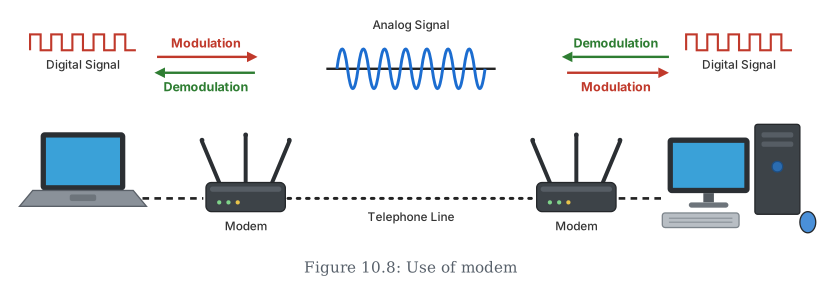
Drawn by us to help you understand the concept clearly, and verified to make sure it's accurate. For exams, practice from your NCERT textbook's own diagram.
A modem's whole job is translating between two different kinds of signal. Your computer only understands digital signals (data as distinct 0s and 1s), but an ordinary telephone line was only built to carry analog signals (smooth, continuous waves).
On the sending side, the modem performs modulation — converting the digital signal into an analog one so it can travel down the phone line. On the receiving side, a second modem performs the reverse: demodulation — converting the analog signal back into digital data the receiving computer can und …