Computer Science · Ch 11 — Data Communication
Need for Protocols
Need for Protocols
Why Protocols Are Needed
A protocol is a set of rules that governs how data is sent, received, and interpreted across a network. Without a common set of rules, devices would not be able to understand each other, and communication would break down. The textbook identifies several key reasons why protocols are essential.
Flow Control
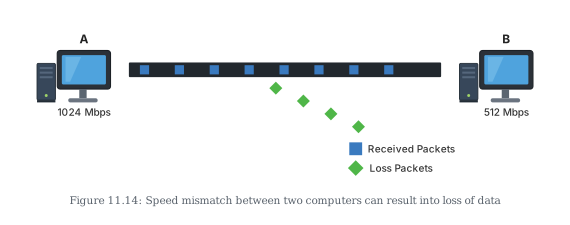
The most immediate problem protocols solve is a mismatch in speed between the sender and the receiver. Consider a scenario where Computer A transmits data at 1024 Mbps, but Computer B can only receive at 512 Mbps. If Computer A keeps sending at full speed, Computer B's buffer will overflow, and data will be lost.
Protocols provide flow control — a mechanism that allows the slower receiver to signal the faster sender to slow down. In the example above, Computer B must be able to inform Computer A about the speed mismatch so that Computer A can adjust its transmission rate. Without this, the faster sender will overwhelm the slower receiver, and the lost data will have to be retransmitted, wasting time and bandwidth.
Access Control
When multiple computers share a single communication link, they cannot all transmit at the same instant. If two or more nodes send data simultaneously over the same shared link, the data packets will collide. A collision corrupts the data, making it unusable.
Access control is the set of rules that decides which node gets to use the shared link at any particular instant. By coordinating access, protocols prevent collisions and ensure that each transmission arrives intact.
Addressing and Identification
Protocols also define how computers identify one another on a network. Every device needs a unique address (like an IP address or MAC address) so that data can be sent to the correct destination. Without addressing, a sender would have no way to specify which machine should receive the data.
Data Formatting and Conversion
Raw data from an application is not in a form suitable for transmission over a network. Protocols specify the exact format to which data must be converted before it is sent. This includes rules for breaking large messages into smaller packets, adding headers, and encoding the data so that it can travel reliably across different types of hardware.
Routing and Forwarding
When a packet arrives at a node, the protocol must decide whether that packet is meant for this node or whether it should be forwarded to another node on the path to the final destination. This decision is made based on the addressing information in the packet header. Protocols define the logic for this forwarding process.
Error Control and Reliability
A fundamental requirement of any communication is that all the data reaches the destination without any loss. Protocols include mechanisms to detect whether packets have been lost, corrupted, or duplicated during transit. If a packet is lost, the protocol arranges for it to be retransmitted. This ensures reliability — the receiver gets exactly what the sender transmitted, in the correct order.
Reassembly at the Destination
Data is often broken into smaller packets for efficient transmission. These packets may travel different routes and arrive out of order. Protocols define how to rearrange the packets back into the correct sequence and process them at the destination to reconstruct the original message. …
Drawn by us to help you understand the concept clearly, and verified to make sure it's accurate. For exams, practice from your NCERT textbook's own diagram.
This illustrates a real problem that comes up whenever two devices with DIFFERENT speeds try to communicate. Computer A can send data at 1024 Mbps, but Computer B can only receive at 512 Mbps — half as fast.
Because A is pushing data out faster than B can take it in, some of what A sends never makes it to B — shown here as the green diamond packets visibly falling away before reaching the other end, while only the blue square packets that B can actually keep up with arrive successfully. This is exactly why real networks need flow control: a …