Physical Education · Ch 10 — Training in Sports
Concept of Talent Identification and Talent Development in Sports
Concept of Talent Identification and Talent Development in Sports
Talent can be described as a natural aptitude or ability in some direction that sits clearly above the normal average — a person with talent can do a thing without having to struggle for it. In sport, however, raw ability is only a starting point; it has to be found and then grown.
Talent identification is the process by which children are guided towards the sport in which they are most likely to succeed, using selected parameters chosen to predict future performance capacity while taking into account the child's present level of fitness and maturity. It is easy to confuse this with talent development, so the distinction matters: identification is the first step in the journey from beginner to successful international athlete, and development is the critical phase that follows, turning identified potential into real sporting success.
The long-term talent-identification system
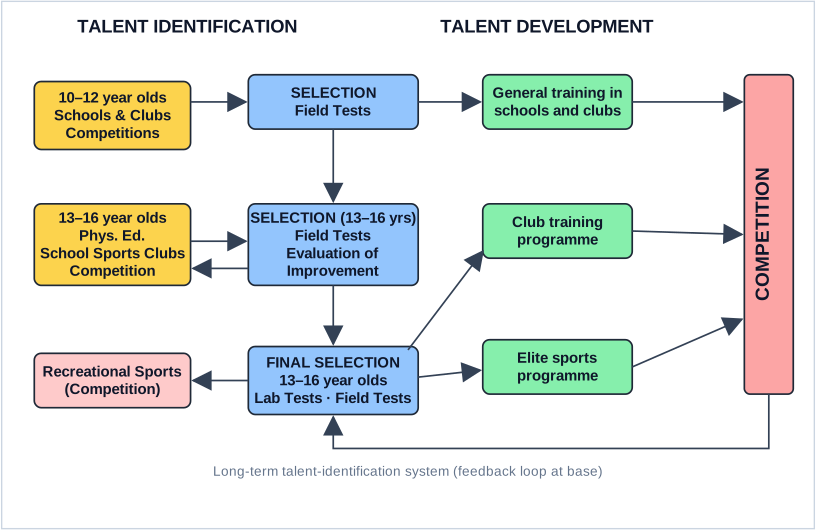
The surest way for a talent-identification programme to reach the greatest number of children is to work closely with schools. The diagram below shows how the long-term system links identification, development and recreational sport.
Drawn by us to help you understand the concept clearly, and verified to make sure it's accurate. For exams, practice from your NCERT textbook's own diagram.
A two-column flow diagram headed 'Talent Identification' on the left and 'Talent Development' on the right, with a vertical 'COMPETITION' strip on the far right. Boxes for 10-12 year-olds (schools and clubs) and 13-16 year-olds feed into selection field tests and a final selection (lab and field tests), which route talented performers into general training, club training and elite sports programmes leading to competition, while ot …
The system works in stages:
- First stage (ages 10-12): simple field tests that are easy to administer, carried out in schools by teachers. Those who look promising are encouraged into general training in schools and clubs.
- Second stage (ages 13-16): again school-based and easy to run, but those selected are then invited for more sophisticated testing by specialists at area or state centres — a battery of field and laboratory tests covering background information, training history, competition results, anthropometric measurements and psychological and physiological tests.
- Final allocation: those finally selected go to elite junior programmes on an event-group basis. Promising performers who are not selected are still encouraged into club training, and all tested youngsters are encouraged to keep taking part in recreational sport. In developing countries the youth-competition structure should be promoted, with tests adapted to local conditions but kept standardised across the whole country.
The process of talent identification and development — five stages
- Talent Detection — discovering potential performers who are not yet involved in the sport in question.
- Talent Identification — recognising, at an early age, participants with the potential to become elite performers in the future.
- Talent Development — giving athletes a suitable learning environment so they can realise and accelerate their potential.
- Talent Selection — the ongoing process of identifying, at various stages of development, individuals who already show the required performance levels.
- Talent Transfer — moving an athlete from one sport to another where there are greater opportunities to succeed.
These five steps are common across sports and are usually built into everyday practice: selection for the next step of a programme is shaped by how the athlete performed in the previous training environment.
Importance of talent identification
- It leads to the discovery of great talent.
- It brings hidden talent to the surface.
- By recognising ability early, children get the chance to show their skills to the fullest.
- It helps the country find and build a genuine sporting asset.
Components of Talent Identification (TID)
The main components are grouped as:
- Physiological attributes
- Physical attributes
- Psychological attributes
- Technical / tactical attributes
- Results
- Intangibles
Steps in talent promotion
- Step I — Screening for the essential training stage: based on health and physique, general physical performance capacity, motives and interest and mental capabilities, and the interest of parents.
- Step II — After 3-4 years of basic training; selection for a group of sports (advanced training stage): based on physique and motor abilities, ability to tolerate load, performance, and cognitive, emotional and personality traits. …