Biology · Ch 4 — Principles of Inheritance and Variation
Sex Determination in Honey Bee
Sex Determination in Honey Bee
The sex of a honey bee is not determined by sex chromosomes like X and Y. Instead, it depends entirely on the number of sets of chromosomes the individual receives — a system called haplodiploidy.
A female honey bee (either a queen or a worker) develops from a fertilised egg — that is, from the union of a sperm and an egg. A male honey bee, called a drone, develops from an unfertilised egg through parthenogenesis (development of an egg without fertilisation). This means the male has only half the number of chromosomes that a female has.
Females are diploid, with 32 chromosomes. Males are haploid, with 16 chromosomes.
This haplodiploid system has several unusual consequences:
- Males produce sperm by mitosis, not meiosis. Since the male is haploid, all his sperm are genetically identical to him.
- A male (drone) has no father — he comes from an unfertilised egg of his mother. Therefore, a drone cannot have sons (because he cannot produce a fertilised egg). However, he does have a grandfather (the queen's father) and can have grandsons (through his daughters, who become queens).
The textbook also asks two comparative questions to help you think about sex determination in birds:
- How is the sex-determination mechanism different in birds?
- Is the sperm or the egg responsible for the sex of the chicks? …
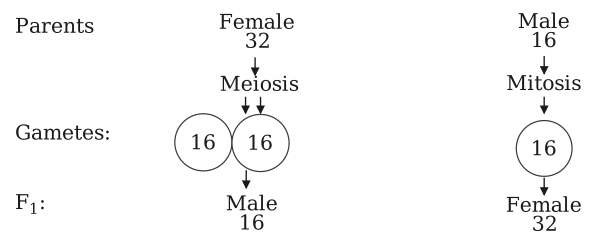
Drawn by us to help you understand the concept clearly, and verified to make sure it's accurate. For exams, practice from your NCERT textbook's own diagram.
The figure is a diagram that illustrates the haplodiploid sex-determination system in honey bees. It is structured as a simple flow chart or family tree, showing how the ploidy (number of chromosome sets) of an egg determines the sex of the offspring.
At the top, the diagram shows a queen bee (the only fertile female in the colony) and a drone (a male bee). The queen is labelled as diploid (2n = 32) — she has two sets of chromosomes, one from each parent. The drone is labelled as haploid (n = 16) — he has only one set of chromosomes, inherited from his mother (the queen) because he develops from an unfertilised egg.
From the queen, two types of eggs are shown: fertilised eggs and unfertilised eggs. A fertilised egg results from the union of a sperm (from a drone) and an egg (from the queen). This fertilised egg is diploid (2n = 32) and develops into a female — either a queen or a worker. The diagram likely uses arrows or branches to indicate that the same diploid genotype can produce two different female castes depending on nutrition (royal jelly for queens, less rich food for workers), though the figure's main focus is on the chromosome number, not caste differentiation.
An unfertilised egg, which is haploid (n = 16), develops parthenogenetically — without fertilisation — into a drone (male). The diagram emphasises that the drone is haploid and has no father, because he inherits all his chromosomes from his mother (the queen). A key arrow or label in the figure shows that drones produce sperm by mitosis, not meiosis. Since the drone is haploid, his sperm are also haploid (n = 16) and genetically identical to him. This is a critical point: a drone cannot have sons because any offspring he fathers would be diploid females (from fertilised eggs), not males. However, a drone can have a grandfather (the drone that fathered his mother, the queen) and can have grandsons (through his daughters, the queens he fathers). …