Q.Consider the following reaction (species labelled (a)–(e) as printed in the Exemplar):
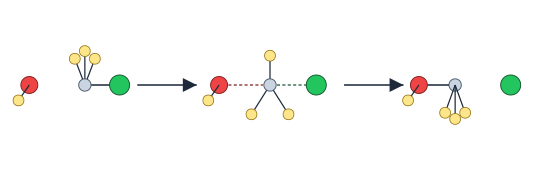
In the printed diagram
Which of the statements are correct about above reaction? (Two or more than two options may be correct.)
You're viewing a preview — the full solution, concept, methods & PYQ mapping are locked.
Start your 14-day free trial to unlock the full solution →
This is an reaction. The transition state (c) has a pentavalent carbon that is hybridised, not . The nucleophile is (a) ; (e) is a leaving group (a nucleophile in other contexts, but here it is the product of nucleophilic attack). The correct statements are (i) and (iii).
1. Identify the reaction type
The species shown — attacking through a single transition state with simultaneous bond-making and bond-breaking — is the classic (bimolecular nucleophilic substitution) mechanism. The key signature: one step, no intermediates, and inversion of configuration at carbon (the "umbrella flip" mentioned in the diagram).
In , the nucleophile attacks from the back side, opposite the leaving group. This causes the three H atoms (or any three substituents) to invert like an umbrella turning inside out — exactly what the problem describes for product (d).
2. What is a nucleophile? What is an electrophile?
- Nucleophile: "nucleus-loving" — a species that donates a lone pair to form a new bond. It is electron-rich.
- Electrophile: "electron-loving" — a species that accepts a lone pair. It is electron-deficient.
In this reaction:
- (a) has a lone pair and a negative charge — it is the nucleophile that attacks carbon.
- (e) is produced when the C–Cl bond breaks. It takes both electrons from that bond, so it is a leaving group. A leaving group is itself a nucleophile (it can donate a lone pair in other reactions), but in this specific step, it is not acting as a nucleophile — it is departing. However, the question asks about the species themselves, not their role in this single step. is indeed a nucleophile in general (it can attack electrophiles). So statement (i) is correct: both (a) and (e) are nucleophiles.
Statement (iv) says both are electrophiles — false. is not electron-deficient; it is electron-rich. is also not an electrophile (it has no empty orbital to accept electrons at low energy). So (iv) is wrong.
A common mistake: thinking that because is a product, it cannot be a nucleophile. But nucleophilicity is a property of the species itself, not its role in a particular step. is a good nucleophile in many reactions (e.g., attacking alkyl halides). So (i) is correct.
3. Hybridisation of carbon in the transition state (c)
In the reactant , carbon is hybridised (four sigma bonds, tetrahedral geometry). In the product , carbon is again hybridised (tetrahedral). But what about the transition state (c)?
In the transition state, the carbon is simultaneously bonded to:
- three H atoms (via sigma bonds),
- the incoming nucleophile (partial bond),
- the leaving group (partial bond).
That makes five groups around carbon. This is a pentavalent carbon. For five electron pairs, the geometry is trigonal bipyramidal (as the problem states). The three H atoms lie in a plane (equatorial positions), and the incoming and leaving groups occupy the axial positions (above and below the plane). …
Unlock everything free for 14 days
- Full step-by-step solutions
- Concept-first explanations
- Methods, shortcuts & mistakes
- PYQ mapping + timed mock tests
Full access for 14 days. No credit card required.