Q.Write the structure of the major organic product in each of the following reactions:
You're viewing a preview — the full solution, concept, methods & PYQ mapping are locked.
Start your 14-day free trial to unlock the full solution →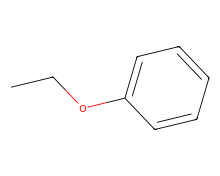
Each reaction follows a specific mechanism (SN2, E2, SN1, etc.) determined by the substrate, nucleophile/base, and solvent. The major product is predicted by applying the correct rule — Markovnikov for electrophilic addition, anti-Markovnikov with peroxides, Zaitsev for elimination, and inversion for SN2.
Let’s go through each reaction one by one, focusing on the why behind the product.
(i)
This is a classic Finkelstein reaction. NaI is soluble in acetone, but NaCl is not — so the reaction is driven by precipitation of NaCl. The substrate is a primary alkyl chloride, so the mechanism is SN2. Iodide is a better nucleophile than chloride, and acetone is a polar aprotic solvent that favours SN2.
Product: (1-iodopropane)
The Finkelstein reaction works best for primary alkyl halides. For secondary or tertiary, elimination competes strongly.
(ii)
Here we have a tertiary alkyl bromide with a strong base (KOH) in ethanol under heat. The substrate is too hindered for SN2, and ethanol is a polar protic solvent that favours E1 or E2. With heat and a strong base, E2 elimination dominates. The major alkene follows Zaitsev’s rule — the more substituted alkene is formed.
The only possible alkene here is 2-methylpropene (isobutylene), because the β-hydrogens are all equivalent.
Product: (2-methylpropene)
Don’t confuse this with an SN1 reaction — tertiary halides can undergo SN1, but with a strong base and heat, elimination is favoured.
(iii)
This is a secondary alkyl bromide with NaOH in water. is a good nucleophile (and a strong base), but in water — a polar protic solvent under moderate conditions — substitution wins over elimination for a secondary substrate; the alcoholic-KOH recipe would have been needed to push elimination. A secondary halide sits at the crossover of the two substitution mechanisms: the protic solvent supports ionisation (the channel) while the good nucleophile supports direct backside displacement (the channel) — and both roads lead to the same product here.
The substitution product is the alcohol: (butan-2-ol). A small amount of elimination product (but-2-ene) may form, but the major product is the alcohol.
Product: (butan-2-ol)
A secondary halide in a protic solvent can react through both and ; with aqueous NaOH the outcome either way is hydrolysis to butan-2-ol. The exam point is that substitution, not elimination, dominates in water — contrast alcoholic KOH, which would eliminate.
(iv)
This is an SN2 reaction on a primary alkyl bromide. Cyanide ion () is a strong nucleophile and a good base, but with a primary substrate in a polar solvent, substitution dominates over elimination. The product is an alkyl cyanide (nitrile).
Product: (propanenitrile)
Alkyl cyanides are useful intermediates — they can be hydrolysed to carboxylic acids or reduced to amines.
(v)
Sodium phenoxide () is a strong nucleophile (the phenoxide ion is resonance-stabilised but still nucleophilic). Ethyl chloride is a primary alkyl halide. The reaction is an SN2 — the phenoxide attacks the carbon bearing the chlorine, displacing chloride. This is a Williamson ether synthesis.
Product: (phenetole, or ethyl phenyl ether)
Phenoxide is a better nucleophile than phenol itself. Using phenol directly would require a base to generate the phenoxide ion first.
(vi)
Thionyl chloride () converts alcohols to alkyl chlorides. The mechanism involves formation of a chlorosulfite intermediate, which is displaced by chloride via an SN2 (for primary alcohols). The reaction is clean because the byproducts ( and HCl) are gases.
Product: (1-chloropropane) …
Unlock everything free for 14 days
- Full step-by-step solutions
- Concept-first explanations
- Methods, shortcuts & mistakes
- PYQ mapping + timed mock tests
Full access for 14 days. No credit card required.