Physics · Ch 12 — Atoms
De Broglie's Explanation of Bohr's Second Postulate of Quantisation
De Broglie's Explanation of Bohr's Second Postulate of Quantisation
The Puzzle of Bohr's Second Postulate
Bohr's second postulate — that the angular momentum of an orbiting electron is quantised as — was a brilliant guess that worked, but it had no physical justification within Bohr's own model. Why should angular momentum come only in those specific lumps? For a decade, this was a deep mystery.
Louis de Broglie, in 1923, provided the missing explanation by taking his own hypothesis seriously: if electrons have a wave nature, then an electron in a circular orbit must be thought of as a wave travelling around that orbit. The key insight is that only those orbits survive in which the electron wave forms a standing wave — just like a plucked string only sustains certain resonant wavelengths.
Standing Waves on a String — The Analogy
When you pluck a string fixed at both ends, many wavelengths are initially excited. But only those wavelengths survive that produce nodes at the ends — that is, the string must contain an exact integer number of half-wavelengths. For a wave travelling down the string and back, the total distance travelled is (where is the string length). The condition for a standing wave is:
Waves that do not satisfy this condition interfere destructively with themselves upon reflection and quickly die out.
Applying the Idea to the Electron Orbit
For an electron moving in the th circular orbit of radius , the wave travels around the circumference. The total distance the wave travels in one complete round trip is the circumference itself:
For a standing wave to persist on this closed loop, the circumference must contain an exact integer number of de Broglie wavelengths :
Figure 12.8 in the textbook illustrates this for : four full wavelengths fit exactly around the circle.
This is the same condition as for a standing wave on a string, but here the wave is on a closed loop — the wave must return to the same point in phase after one complete revolution.
Connecting to de Broglie Wavelength
From Chapter 11, the de Broglie wavelength of a particle is:
where is the magnitude of the particle's momentum. For an electron moving at speed (non-relativistic, ), the momentum is . Therefore:
Substitute this into the standing-wave condition (12.12):
Deriving Bohr's Quantisation Condition
Rearrange the equation above:
This is exactly Bohr's second postulate! The left-hand side is the magnitude of the electron's angular momentum (for a circular orbit, ). So we have:
Thus, de Broglie's hypothesis provides a natural physical explanation: the quantised orbits are those for which the electron wave forms a standing wave around the nucleus. Only these resonant standing waves can persist; all other waves interfere destructively and vanish. The discrete orbits and energy levels of the hydrogen atom are a direct consequence of the wave nature of the electron.
What This Means for the Bohr Model
The success of this explanation is profound. It shows that Bohr's seemingly arbitrary quantisation condition is not arbitrary at all — it follows from the wave-particle duality of matter. The electron is not a tiny planet; it is a wave that must "fit" around its orbit.
However, this does not mean the Bohr model is fully correct. The model still uses a classical trajectory picture (a particle moving in a circle), which is inconsistent with the uncertainty principle. Modern quantum mechanics replaces the notion of well-defined orbits with probability clouds (orbitals). But de Broglie's explanation was a crucial step that connected Bohr's semi-classical model to the deeper wave nature of matter.
Limitations of the Bohr Model (Revisited)
The textbook lists several limitations that remain even after de Broglie's explanation:
- Applicability only to hydrogenic atoms — atoms with a single electron (H, He, Li, etc.). For multi-electron atoms, the electron-electron interactions are comparable in strength to the electron-nucleus interaction, and Bohr's simple picture fails completely. …
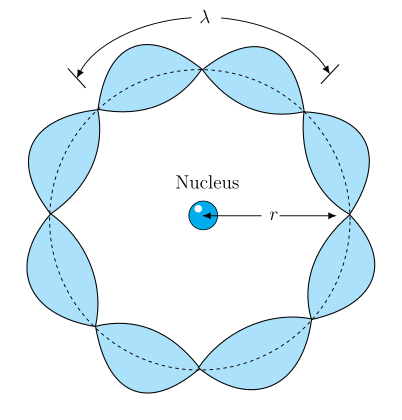
Drawn by us to help you understand the concept clearly, and verified to make sure it's accurate. For exams, practice from your NCERT textbook's own diagram.
Fig. 12.8 is a schematic diagram, not a plot with axes. It shows a dashed circle of radius representing the electron’s orbit around a central nucleus. Superimposed on this circle is a continuous, wavy line that loops around the circumference exactly four times — that is, four complete wavelengths of the electron’s de Broglie wave fit into one full trip around the orbit. The wave pattern is drawn as a standing wave: it has four lobes (alternating crests and troughs) that join smoothly onto themselves, with no discontinuity or mismatch where the wave meets itself after one revolution.
The key physical idea is that the electron, behaving as a wave, can only persist in orbits where its wave returns to the same phase after completing one circuit. If the circumference is not an integer multiple of the de Broglie wavelength , the wave would interfere destructively with itself and cancel out. Only when
does a stable standing wave form. The figure illustrates the case , so .
Using de Broglie’s relation , and for an electron of mass moving with speed (non-relativistic, so ), the condition becomes
Rearranging gives
which is exactly Bohr’s quantisation condition for angular momentum. Thus the figure visually demonstrates how wave nature forces angular momentum to be quantised: only those orbits that can host an integer number of de Broglie wavelengths are allowed.
The standing-wave condition is the direct link between de Broglie’s hypothesis and Bohr’s second postulate. It shows that quantised orbits are not an arbitrary assumption — they are a natural consequence of requiring the electron wave to be a resonant standing wave. …