Physics · Ch 5 — Magnetism and Matter
Magnetism and Gauss's Law
Magnetism and Gauss's Law
The Core Idea: Why Magnetism is Different from Electricity
Gauss's Law for magnetism is a fundamental statement about the nature of magnetic fields. Unlike electric fields, which can start and end on charges, magnetic field lines are continuous and form closed loops. This means there are no isolated magnetic "charges" (monopoles). The simplest magnetic object is a dipole (like a bar magnet) or a current loop.
The Law: Net Magnetic Flux Through Any Closed Surface is Zero
Consider any closed surface (like a sphere or a box). The magnetic flux () through it is the total number of magnetic field lines passing through it.
- For electric fields: The net flux through a closed surface is proportional to the net charge enclosed (). If you enclose a positive charge, more lines leave than enter.
- For magnetic fields: Because field lines are closed loops, every line that enters a closed surface must also leave it. The number of lines entering is always exactly balanced by the number leaving.
Therefore, the net magnetic flux through any closed surface is always zero.
The Mathematical Statement
We define the magnetic flux through a tiny area element (a vector whose magnitude is the area and direction is normal to the surface) as:
where is the magnetic field at that element.
To find the total flux through a closed surface , we sum (integrate) over all these tiny elements:
This is the mathematical form of Gauss's Law for Magnetism.
Comparison with Gauss's Law for Electrostatics
| Feature | Electrostatics | Magnetism |
|---|---|---|
| Source of field | Electric charges ( and ) | Moving charges (currents), magnetic dipoles |
| Fundamental unit | Monopole (single charge) | Dipole (no isolated poles) |
| Field lines | Start on charges, end on charges | Form continuous closed loops |
| Gauss's Law |
The right-hand side is zero for magnetism because isolated magnetic poles (monopoles) do not exist. If they did, the law would be modified to , where is the enclosed magnetic charge.
Key Implications (from the Examples)
- Field lines never start or end: A diagram showing field lines emanating from a point (like a positive charge) is wrong for magnetism.
- Field lines never cross: The direction of the field would be ambiguous at the crossing point.
- Static magnetic field lines must enclose a current: A closed loop of a static magnetic field cannot exist in empty space; it must wrap around a current-carrying wire. …
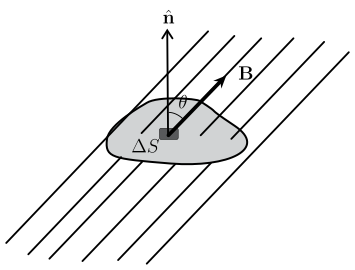
Drawn by us to help you understand the concept clearly, and verified to make sure it's accurate. For exams, practice from your NCERT textbook's own diagram.
What the Figure Shows
The diagram depicts a uniform magnetic field — several parallel, straight field lines running diagonally from lower-left to upper-right. Embedded in this field is a small, flat area element , shown as a shaded oval or parallelogram patch. From this patch, an outward unit-normal vector points up-left. A magnetic field vector (bold, with an arrowhead) lies along one of the field lines. At the patch, the angle between and is marked. The labels , , , and are all present.
The Physical Idea
This figure is the visual foundation for Gauss’s law of magnetism. It shows how to compute the magnetic flux through a tiny piece of a closed surface. The key insight: because magnetic field lines form continuous closed loops (unlike electric field lines, which can start or end on charges), the number of field lines entering any closed surface exactly equals the number leaving it. The net magnetic flux through any closed surface is therefore always zero.
The Key Formula
The magnetic flux through the small area element is defined as:
where:
- is the magnetic field vector at the location of ,
- is the vector area element: its magnitude is the area , and its direction is along the outward normal (so ).
Using the dot product, this becomes:
where is the angle between and (exactly the angle marked in the figure).
To get the net magnetic flux through an entire closed surface , we sum over all such area elements: …