Business Mathematics and Statistics · Ch 3 — Analytical Geometry (Locus, Straight Lines, Pair of Straight Lines, Circles, Conics)
Equation of a Straight Line — Standard Forms
Equation of a Straight Line — Standard Forms
A straight line can be written in several equivalent algebraic forms; which one to use depends on what information the problem gives — a point and a slope, two points, or the two axis-intercepts. Every form can always be rearranged into the single general form .
Slope (point-slope) form — given one point on the line and its slope :
Two-point form — given two points and on the line, the slope is (for ), and the equation is:
Intercept form — given the -intercept and the -intercept (the points where the line crosses each axis):
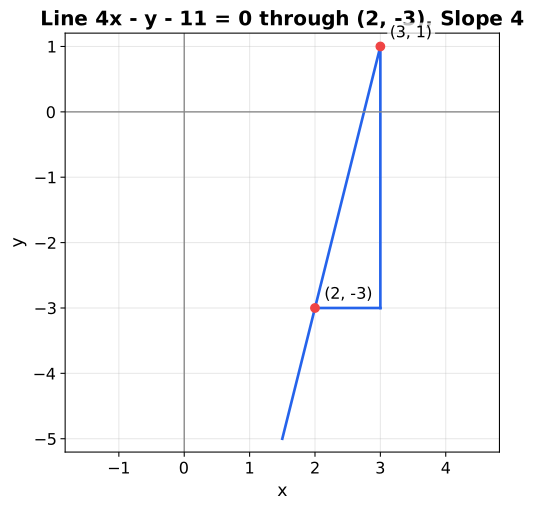
For a line through and , the slope is — the rise per unit run. A positive slope rises left to right, a negative slope falls, a slope of is horizontal, and …
Point-slope form is used when a point and the slope are known; two-point form is used when two points on the line are known instead — it is really point-slo …
Intercept form is convenient when the axis crossings are known directly. The general (standard) form is the form every other form reduces to, and is the one most useful …