Economics · Ch 2 — Consumption Analysis
Budget Line (Price Line)
Budget Line (Price Line)
While an indifference map shows what combinations of two goods a consumer would EQUALLY LIKE to have, it says nothing about which of them he can actually afford — that depends on his income and the prices of the two goods. The Budget Line (also called the Price Line) is the locus of all combinations of two goods that a consumer can purchase by spending his ENTIRE money income, given fixed prices for both goods.
If a consumer has income to spend on goods X (price ) and Y (price ), the budget line's equation is:
Setting gives the X-intercept, — the maximum units of X the consumer could buy if he spent his ENTIRE income on X alone. Setting gives the Y-intercept, — the maximum units of Y he could buy spending it all on Y. The slope of the budget line, obtained by rearranging the equation as , is — the NEGATIVE of the price ratio of the two goods. This slope tells us the real, market-given rate at which X can be exchanged for Y: to buy one more unit of X, the consumer must give up exactly units of Y.
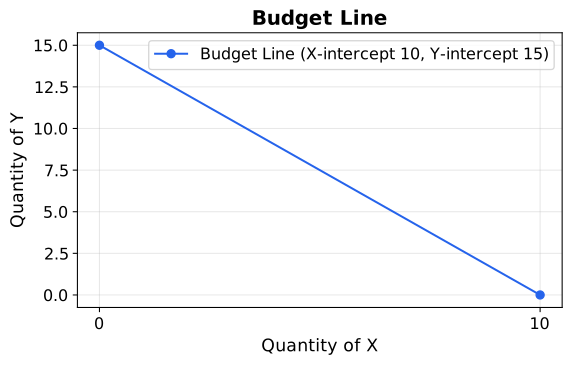
The locus of all combinations of two goods a consumer can buy by spending his entire income at given prices; its equati …