Computer Science · Ch 3 — Emerging Trends
Immersive Experiences
Immersive Experiences
Three-dimensional (3D) videography has taken the joy of watching movies in theatres to a new level, and video games are increasingly built to pull the player right inside the action. Both point to the same emerging trend: the immersive experience.
What is an immersive experience?
An immersive experience lets us visualise, feel and react by stimulating our senses. Because our senses are engaged directly, our interaction and involvement with the content becomes far more realistic and engaging than watching a flat screen.
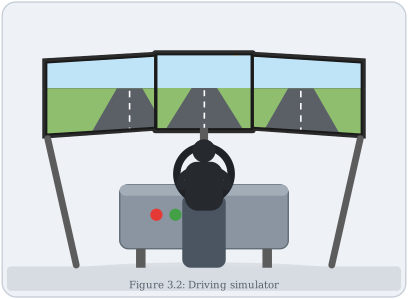
Beyond entertainment, immersive experiences are heavily used in training — for example driving simulators (Figure 3.2) and flight simulators, where a learner can practise safely in a realistic, simulated environment.
Immersive experience is achieved through two related technologies: Virtual Reality and Augmented Reality.
(A) Virtual Reality (VR)
Everything we experience as "reality" reaches us through our senses. This leads to a powerful idea: if we could feed our senses made-up (non-real) information, our perception of reality would change in response.
That is exactly what Virtual Reality (VR) does. VR is a three-dimensional, computer-generated situation that simulates the real world. Key points:
- The user is immersed inside the generated environment and can interact with and explore it — manipulating objects and performing actions, much as in the real world.
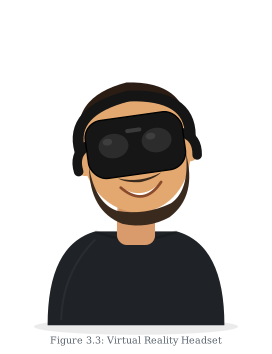
- At present VR is delivered through VR headsets.
- To make the experience more realistic, VR also supplies other sensory information — sound, smell, motion, temperature and so on — not just visuals.
VR is a comparatively new field, with applications in:
- gaming (Figure 3.3)
- military training
- medical procedures
- entertainment
- social science and psychology
- engineering
- any other area where simulation helps understanding and learning.
(B) Augmented Reality (AR)
Augmented Reality (AR) is the superimposition of computer-generated perceptual information over the existing physical surroundings. Instead of replacing the world (as VR does), AR adds components of the digital world to the physical world, together with the associated tactile and other sensory requirements — making the environment interactive and digitally manipulable.
A common use is location-based information:
- Users can access information about the nearest places relative to their current location, and choose between places based on user reviews.
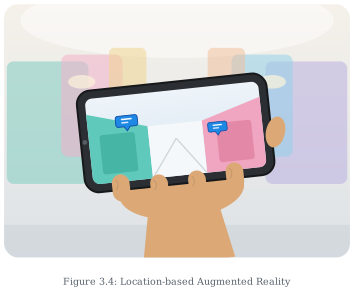
- With a location-based AR app, a traveller can get real-time information about historical places simply by pointing the phone's camera viewfinder at them (Figure 3.4). Location-based apps are the major form of AR apps today. …
Drawn by us to help you understand the concept clearly, and verified to make sure it's accurate. For exams, practice from your textbook's own diagram.
This photograph shows a driving simulator — the textbook's first concrete example of an immersive experience used for training. A man in a dark suit sits in a simulator rig, holding a steering wheel mounted on a console, exactly as he would sit in a real car.
The immersive element is the display: three large screens wrap around the driver, showing a first-person view of a road. Because the imagery surrounds him rather than sitting on a single flat monitor, his senses are engaged much as they would be behind a real windscreen — he can visualise, feel and react to the simulated traffic situation. …
Drawn by us to help you understand the concept clearly, and verified to make sure it's accurate. For exams, practice from your textbook's own diagram.
This photograph shows the device through which Virtual Reality is delivered today: the VR headset. A bearded man wears a black headset that completely covers his eyes; his head is tilted slightly upward and he is smiling, evidently reacting to something he sees inside the headset. (He wears a black T-shirt printed with the words "SUPER CHARGE".)
The covered eyes are the key detail. Because the headset blocks out the real surroundings entirely and replaces them with a three-dimensional, computer-generated environment, the wearer is immersed in a simulated world — he looks upward at things that exist only in the simulation. This is precisely how the section defines VR: a computer-generated situation that simulates the real world, which the user explores and interacts with while immersed in it. …
Drawn by us to help you understand the concept clearly, and verified to make sure it's accurate. For exams, practice from your textbook's own diagram.
This photograph demonstrates location-based Augmented Reality — the major form of AR apps. A hand holds a smartphone horizontally inside a shopping mall. On the phone's screen is the live camera view of the mall corridor, but with a difference: small blue augmented-reality information tags and labels are superimposed over the storefronts. Behind the phone, the real mall interior is visible (blurred), so the viewer can compare the plain physical scene with its digitally annotated version on the screen.
The contrast between the two views is the whole lesson. AR does not create a new world; it superimposes computer-generated perceptual information over the existing physical surroundings. The corridors and shops are real — the phone merely adds a layer of digital information about them, keyed to the user's current location. …