Physical Education · Ch 8 — Biomechanics and Sports
Levers
Levers
A lever is a type of simple machine, and the human body uses levers as its mechanism for movement. Although levers belong to the skeletal system, it is the muscles that supply the force to work them: the bony levers stay still until the muscles move them, and the muscles themselves stay inactive until the nervous system stimulates them.
The four components of a lever
Every lever system is made up of four parts:
- Load — the object (or resistance) to be moved.
- Effort — the muscular force used to move the load.
- Fulcrum — the joint about which the movement takes place.
- Lever — the bone itself.
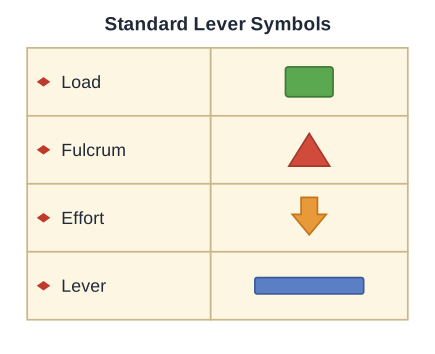
A diagram of any lever system must show all four parts. Standard symbols are used to represent each one, and you should be able to recognise them:
Drawn by us to help you understand the concept clearly, and verified to make sure it's accurate. For exams, practice from your textbook's own diagram.
A key showing the four standard symbols used throughout every lever diagram in this chapter, so that any lever system -- inside the body or in a piece of sports equipment -- can be drawn and read the same way. The green square marks the load (the resistance being moved), the red triangle marks the fulcrum (the fixed pivot point about which the lever turns), the orange arrow marks the effort (the muscular force applied to move the load), and the blue bar represents the lever itself (the rigid bone or implement). Learning to recognise these four symbols lets a student correctly identify which compone …
Definition of a lever
A lever is a rigid bar used to overcome resistance when a force is applied — a rigid piece that transmits and modifies force or motion when forces are applied at two points and it turns about a third.
- The fulcrum — the point about which the lever rotates. Its position relative to the other two parts decides the class of the lever; in the body it is the joint that dictates the kind of action. …