Physical Education · Ch 4 — Physical Education and Sports for CWSN (Children With Special Needs – Divyang)
Organizations promoting Disability Sports
Organizations promoting Disability Sports
Disability refers to limitations in an individual's functioning. It covers physical impairment, intellectual impairment, cognitive impairment, sensory impairment, mental illness and various kinds of chronic disease. A person with a disability is often unable to take part in sport and physical education not only because of the impairment itself but also because of attitudinal and environmental barriers — the opinions of other people and the way facilities and equipment are designed.
Organised sport for athletes with an impairment is more than a hundred years old. The first sports clubs for the deaf already existed in Berlin in 1888. Competitive games for people with special needs, however, became widespread only after the Second World War, when there was a pressing need to help the large numbers of war veterans and soldiers who had been injured. In 1944 Dr Ludwig Guttmann opened a spinal-injuries centre at Stoke Mandeville Hospital in Britain, where sport was used first for rehabilitation, then for recreation and finally for competition. In 1948, on the day the London Olympic Games opened, Guttmann held the first wheelchair competition in history and named it the Stoke Mandeville Games; these later grew into the Paralympic Games, first staged in Rome in 1960.
Sport for people with intellectual disabilities, later promoted as the Special Olympics, began when Eunice Kennedy Shriver ran a summer day camp in the backyard of her Maryland home in the 1960s. The first International Special Olympics Games followed in July 1968 at Soldier Field, Chicago. Sport for people with hearing impairment was promoted through the International Committee of Sports for the Deaf (ICSD), the governing body of the Deaflympics since 1924, whose first event — the International Silent Games — was held in Paris in 1924. The Deaflympic Winter Games began in 1949. …
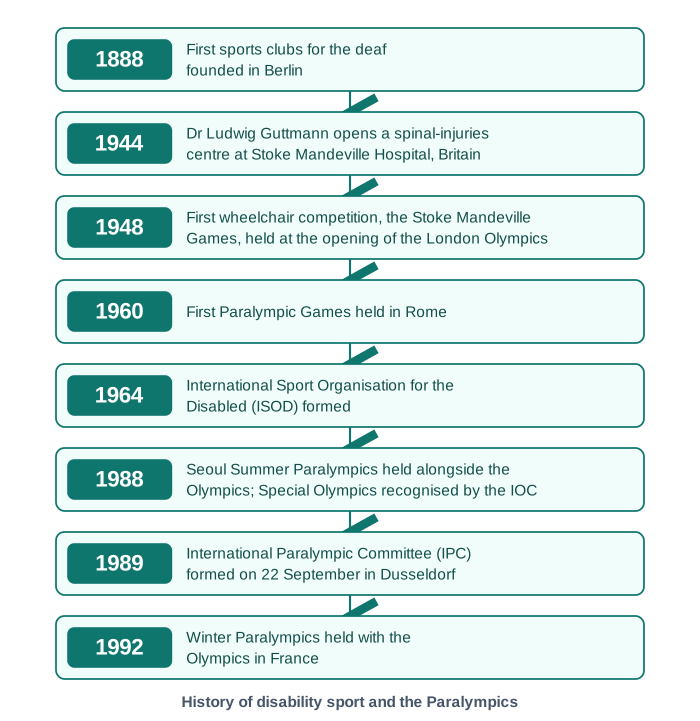
Drawn by us to help you understand the concept clearly, and verified to make sure it's accurate. For exams, practice from your textbook's own diagram.
A vertical timeline flowchart of eight dated year-boxes joined top to bottom by down arrows, tracing the history of disability sport and the Paralympics: 1888 (first sports clubs for the deaf founded in Berlin); 1944 (Dr Ludwig Guttmann opens a spinal-injuries centre at Stoke Mandeville Hospital, Britain); 1948 (Guttmann holds the first wheelchair competition, the Stoke Mandeville Games, at the opening of the London Olympics); 1960 (first Paralympic Games held in Rome); 1964 (International Sport Organisation for the Disabled, ISOD, formed); 1988 (Seoul Summer Paralympics held alongside the Olympics, and the Special Olympics recognised by the IOC); 1989 (International Paralympic Committee, IPC, formed on 22 September in Dusseldorf …