Mathematics · Ch 1 — Applications of Matrices and Determinants
Application of Matrices to Geometry
Application of Matrices to Geometry
Matrices give a compact way to describe geometric transformations of the plane, and one of the most important is the rotation of the axes. (In the Tamil Nadu Samacheer Kalvi Class 12 Maths syllabus this topic follows the same NCERT/CBSE curriculum treatment of matrices and orthogonal transformations.)
Let be the origin and let and be the original - and -axes. A point has coordinates in this system. Now rotate both axes about through an angle to obtain the new axes and ; with respect to these new axes the same point has coordinates .
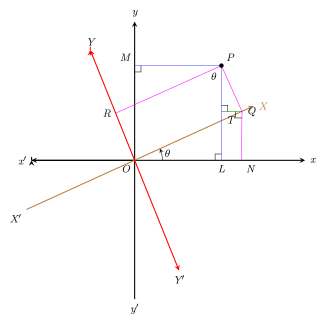
Drawn by us to help you understand the concept clearly, and verified to make sure it's accurate. For exams, practice from your textbook's own diagram.
What this figure shows. The original axes and and the new axes , obtained by rotating about the origin through an angle . A point is dropped perpendicularly onto both systems; the construction points give the projections used to derive and $y …
Reading the perpendicular projections in the figure gives
In matrix form,
The matrix is the rotation matrix. Its determinant is
so is non-singular and invertible, with
Hence the reverse transformation is
…