Mathematics · Ch 1 — Applications of Matrices and Determinants
Solution to a System of Linear Equations
Solution to a System of Linear Equations
What counts as a solution. For : solving gives the unique pair , which satisfies both equations -- the two lines meet at exactly one point, and the system is called consistent with a unique solution.
For : the second equation is just the first doubled, so every solution of the first automatically solves the second. Fixing (any real number) gives -- infinitely many solutions, one for every (the two equations describe the same line). The system is consistent with infinitely many solutions.
For : substituting from the first into the second gives the contradiction -- no pair satisfies both (the lines are parallel and distinct). The system is inconsistent, with no solution.
Definition 1.8. A system with at least one solution is consistent; a system with no solution is inconsistent.
Note. Interchanging two equations, scaling one equation by a non-zero constant, or replacing one equation by itself plus a non-zero multiple of another, never changes the solution set -- exactly the three elementary row operations of §1.3.1, now acting on equations instead of matrix rows.
Remark. When the number of equations equals the number of unknowns, the coefficient matrix is square. If is additionally non-singular, the system can be solved by any of three methods developed next: matrix inversion (§1.4.3.1), Cramer's rule (§1.4.3.2), or Gaussian elimination (§1.4.3.3). …
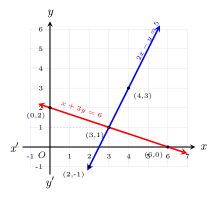
Drawn by us to help you understand the concept clearly, and verified to make sure it's accurate. For exams, practice from your textbook's own diagram.
What this figure shows. The two straight lines and intersecting at the single point . Because they meet at exactly one point, the system is consistent with a unique solution. …
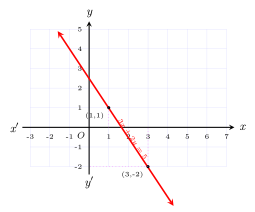
Drawn by us to help you understand the concept clearly, and verified to make sure it's accurate. For exams, practice from your textbook's own diagram.
What this figure shows. A single straight line (the equation is just twice it, so the two lines coincide), passing through points such as and . The system is consistent with infinitely many solutions. …
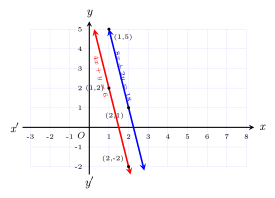
Drawn by us to help you understand the concept clearly, and verified to make sure it's accurate. For exams, practice from your textbook's own diagram.
What this figure shows. The two parallel straight lines and (same slope, different intercepts), which never intersect. The system is inconsistent and has no solution. …