Mathematics · Ch 12 — Discrete Mathematics
Definitions
Definitions
Starting from a familiar example. Take the ordinary addition and multiplication of natural numbers, and for . Both operations share two features: (1) exactly two elements of are processed at a time, and (2) the resulting element is again in . Any operation on a non-empty set with these two features is called a binary operation (or binary composition) in abstract algebra.
Definition 12.1. An operation defined on a non-empty set is a binary operation on if:
- is defined for every ordered pair , and
- it assigns a unique element to every such ordered pair.
In other words, is a rule (a function/mapping) with input in the Cartesian product and output in :
where is a single, unambiguous element. Because the output is required to lie in itself and never outside it, we say is closed on , or is closed with respect to -- the closure property. Every binary operation automatically satisfies closure, by definition. Definition 12.2. A non-empty set on which one or more binary operations are defined is called an algebraic structure. An equivalent way to state Definition 12.1: is unique and . The symbol is generic -- depending on the set it may stand for , matrix addition, matrix multiplication, and so on. Why not every "obvious" operation is binary -- and why number systems keep expanding. and are binary on , but is not: for , . So is extended to , on which is binary; is an algebraic structure. The same pattern repeats:
- is not binary on : for , -- forcing the extension .
- Division by is never defined, so is binary on , not on all of .
- Needing roots of equations such as (irrational) and (imaginary) forces . is the biggest of these systems, properly containing as subsets.
Table 12.1 summarises which of are binary on each number system:
| Operation | ||||||||
|---|---|---|---|---|---|---|---|---|
| Binary | Binary | Binary | Binary | Binary | Not Binary | Not Binary | Not Binary | |
| Not Binary | Binary | Binary | Binary | Binary | Not Binary | Not Binary | Not Binary | |
| Binary | Binary | Binary | Binary | Binary | Binary | Binary | Binary | |
| Not Binary | Not Binary | Not Binary | Not Binary | Not Binary | Binary | Binary | Binary |
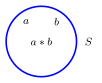
Drawn by us to help you understand the concept clearly, and verified to make sure it's accurate. For exams, practice from your textbook's own diagram.
What this figure shows. Closure property of a binary operation: for a non-empty set , if then the unique element also li …