Skip to content

Mathematics · Ch 4 — Inverse Trigonometric Functions

Graph of the Inverse Cotangent Function

4.8.3

Graph of the Inverse Cotangent Function

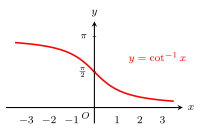
y=cot⁡−1xy=\cot^{-1}x has domain R\mathbb{R} and range (0,π)(0,\pi) — that is, cot⁡−1:R→(0,π)\cot^{-1}:\mathbb{R}\to(0,\pi), the only one of the six inverse trig functions defined for EVERY real number with no gap in either domain or output.

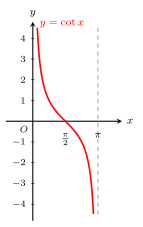
Fig. 4.29 shows the restricted cotangent curve on (0,π)(0,\pi), and Fig. 4.30 its reflection in y=xy=x: a strictly DECREASING, flattening curve running from just below π\pi (as x→−∞x\to-\infty) through (0,π2)\left(0,\tfrac{\pi}2\right) down to just above 00 (as x→∞x\to\infty), hugging the two horizontal asymptotes y=0y=0 and y=πy=\pi. …

Figure 4.29Graph of y = cot x on the restricted domain (0, pi): a single strictly decreasing branch from infinity through (pi/2, 0) to minus infinity; vertical asymptotes at x = 0 and x = pi.
Fig. 4.29 — Graph of y = cot x on the restricted domain (0, pi): a single strictly decreasing branch from infinity through (pi/2, 0) to minus infinity; vertical asymptotes at x = 0 and x = pi.

Drawn by us to help you understand the concept clearly, and verified to make sure it's accurate. For exams, practice from your textbook's own diagram.

What this figure shows. A single steeply falling branch from +∞+\infty near x=0x=0 to −∞-\infty near x=πx=\pi, crossing y=0y=0 at x=π/2x=\pi/2. …

Figure 4.30Graph of y = cot^{-1} x on domain (-infinity, infinity): a strictly decreasing S-curve from pi (as x tends to minus infinity) through (0, pi/2) to 0 (as x tends to infinity); range (0, pi).
Fig. 4.30 — Graph of y = cot^{-1} x on domain (-infinity, infinity): a strictly decreasing S-curve from pi (as x tends to minus infinity) through (0, pi/2) to 0 (as x tends to infinity); range (0, pi).

Drawn by us to help you understand the concept clearly, and verified to make sure it's accurate. For exams, practice from your textbook's own diagram.

What this figure shows. A strictly decreasing flattening curve running from just below π\pi (as x→−∞x\to-\infty) through (0,π/2)\left(0,\pi/2\right) down to just above 00 (as x→∞x\to\infty), hugging horizontal asymptotes y=0y=0 and y=πy=\pi. …