Mathematics · Ch 5 — Two Dimensional Analytical Geometry-II
Equations of Tangent and Normal at a Point on a Given Circle
Equations of Tangent and Normal at a Point on a Given Circle
Diameter form (Theorem 5.2). Let and be the two ends of a diameter, and any point on the circle. Since an angle in a semicircle is a right angle, , so the chords and are perpendicular and the product of their slopes is :
the equation of the circle with as the ends of a diameter.
Theorem 5.3 (position of a point relative to a circle). For the circle with centre and radius , and a point : draw , meeting the circle at . Then is outside/on/inside the circle according as , i.e. according as
So simply substituting the point's coordinates into the circle's expression (call this value ) and reading its sign tells you instantly where the point lies — no distance computation needed.
Tangent and normal at a point on the circle. For and both on , subtracting their two equations and simplifying gives the slope of chord as . Letting turns the chord into the tangent at , with slope ; substituting this slope into the point-slope form and simplifying (using that itself satisfies the circle's equation) gives the clean result
The normal, perpendicular to the tangent at the same point, has slope and simplifies to …
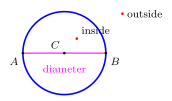
Drawn by us to help you understand the concept clearly, and verified to make sure it's accurate. For exams, practice from your textbook's own diagram.
What this figure shows. A semicircle with the diameter endpoints and a point on the circle showing ; and a point joined to the centre , meeting the circle at , used to compare with the radius . …